
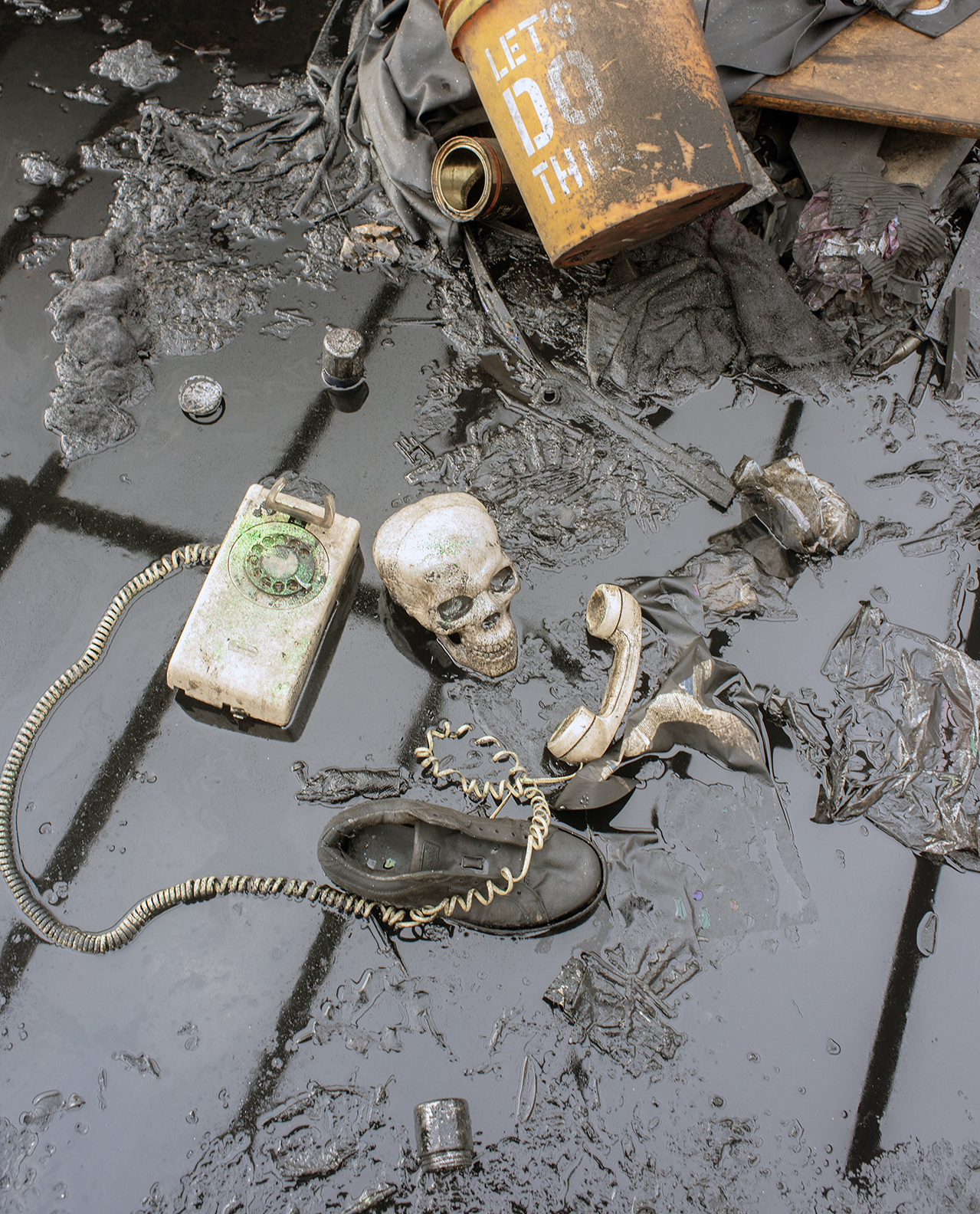
Top picture – An old phone is part of a toxic waste site in the Junkyards in Queens. The old dead technology lasted almost a century, and, was just the beginning of quickly developing virtual representations and by adding portability, a computer and a camera, the new phones have become appendages that can screen and filter as programmed by us.
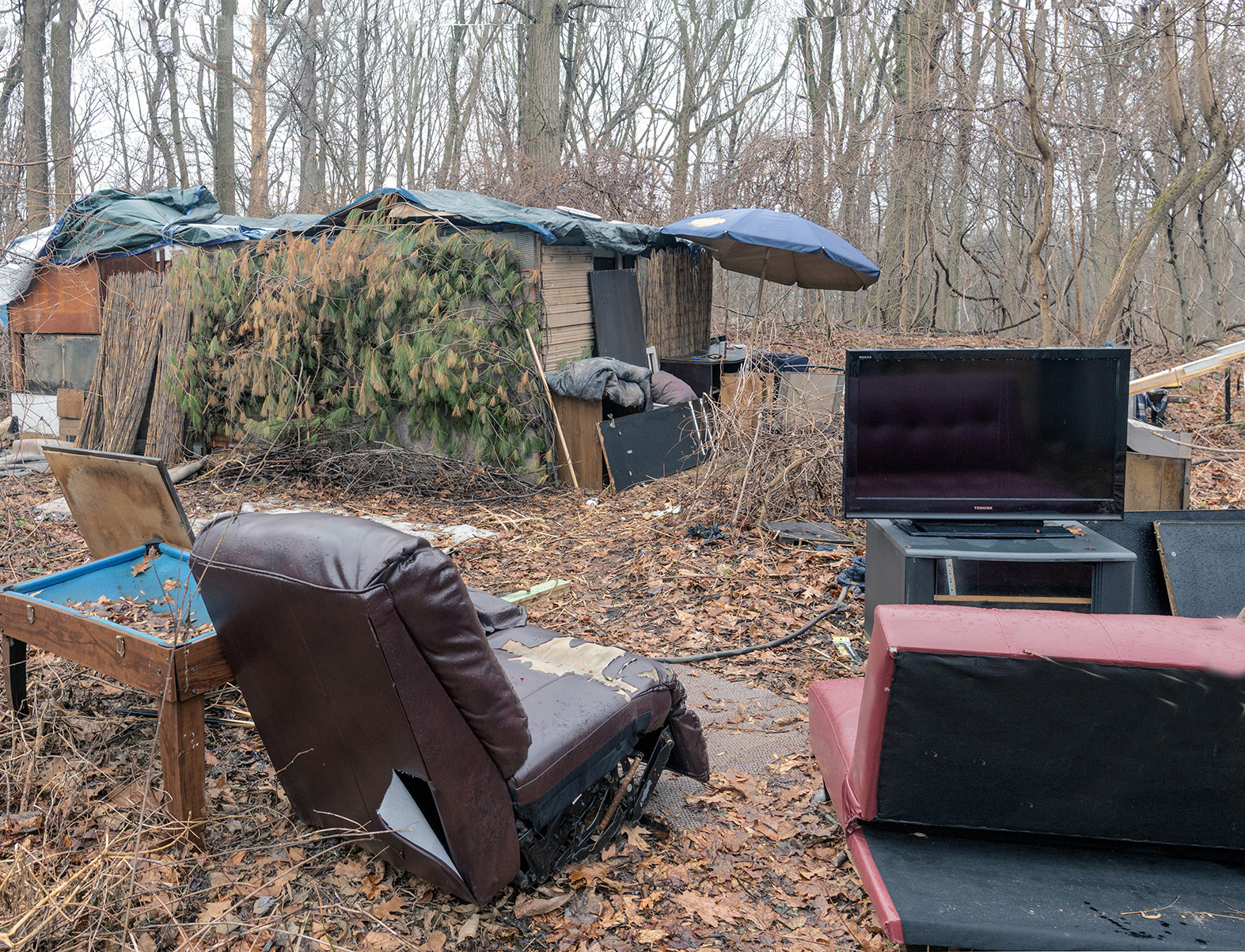
Bottom Picture – Adrian’s Ranch in Van Cortlandt Park in the Bronx. Even without electricity, a home is not complete until a large screen is added. Whether it works or not. He built an entire compound of multiple buildings from found and scrapped material, hauled a great distance into the woods of the Northwest Forest of Van Courtlandt
Art imagined itself as the great disruptor beginning in the 1980s. It saw itself as the early warning system for culture, the place where the future showed up first. That self-image has outlived its usefulness. What once passed for disruption hardened into an aesthetic, mingled, sometimes guided by theory. The work didn’t get riskier. It got more academic. And now it shows, as the most powerful academic institutions get blindsided by a new reality that, whether you like it or not, hits harder than the arguments built to explain it. Guess what. That’s no longer cool.
The ground didn’t disappear. It shifted.
Disruption didn’t vanish. It changed hands. The forces reshaping daily life no longer sit in studios. They sit in the White House, in boardrooms, and in server farms. The old self-appointed radicals didn’t anticipate that shift. They missed it. Worse, they aestheticized it. The originators of disruption didn’t predict the future. They were overtaken by it, absorbed by it, and displaced by it.
Here’s the ironic inversion. The original counterculture tried to expose illusion, power, and manufactured consent. The modern right, especially Republicans under Trump, flipped the strategy and weaponized it. They didn’t reject media manipulation. They mastered it. They didn’t challenge spectacle. They flooded it. Irony, performance, provocation, anti-institutional posture, contempt for expertise, suspicion of consensus. All of it lifted, inverted, and redeployed. What once aimed to puncture false reality now works to replace it entirely.
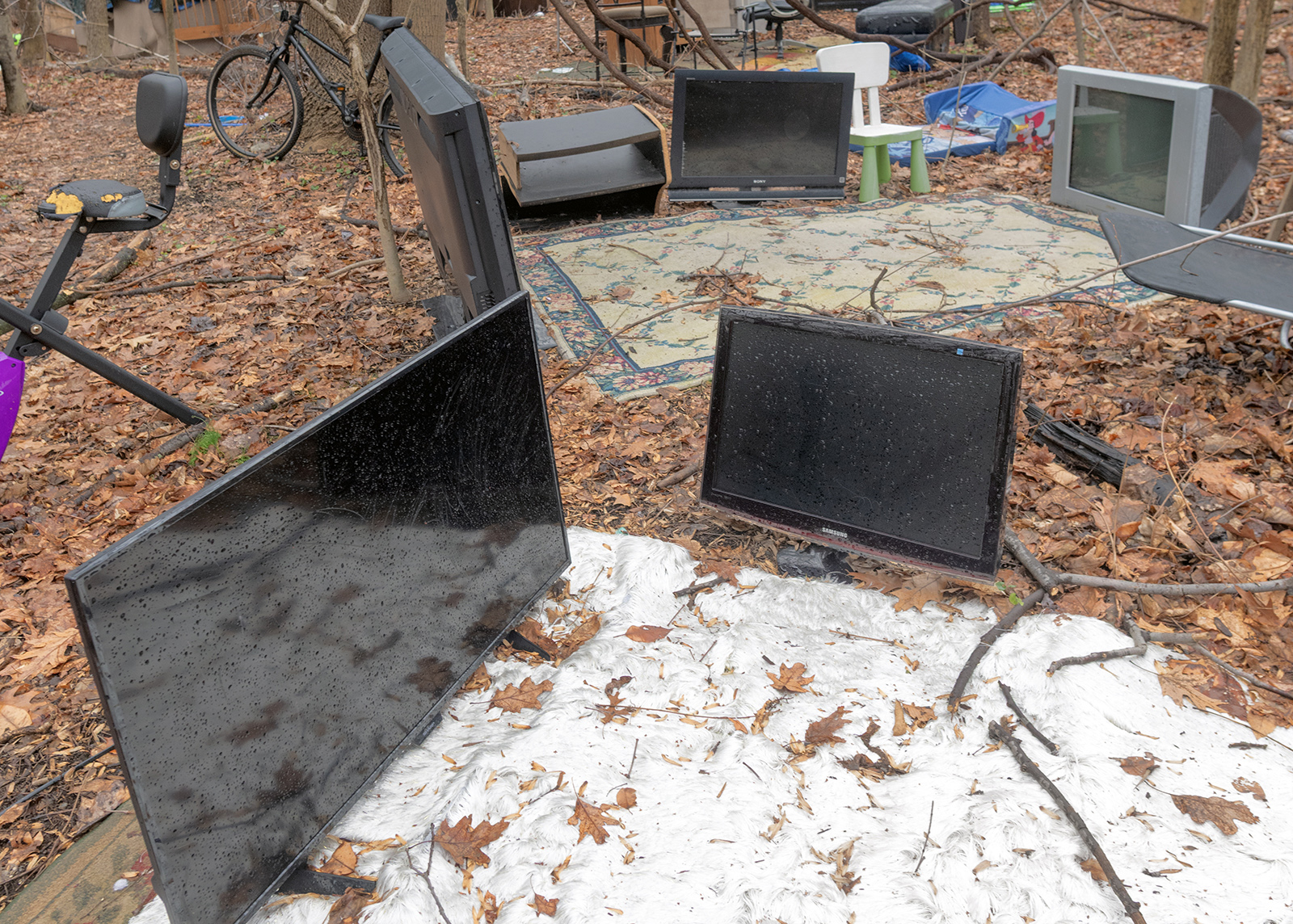 Did Adrian collect all the screens because they provided him comfort? Big screens are synonymous with home and little screens to go anywhere.
This is the opposite of the old counterculture’s stated goals, but it uses the same tools. Distrust everything. Undermine shared facts. Turn outrage into entertainment. It isn’t rebellion. It’s takeover. The left theorized disruption. The right operationalized it. One side debated meaning. The other learned how to bend attention, emotion, and belief at scale.
There’s a persistent myth that artists from the late 1970s through the 1990s predicted all this. In one narrow sense, that myth isn’t wrong. Those artists were early in their distrust of media hegemony. They questioned news outlets, images, authority, consensus, and the idea that truth arrived intact from institutions. That suspicion was real. And for a time, it mattered.
What they didn’t foresee was how that distrust would be absorbed, weaponized, and turned against reality itself. They believed exposing illusion would weaken power. They assumed that once the mechanics of manipulation were revealed, people would demand something better. What they missed was that distrust doesn’t automatically lead to clarity. It can just as easily lead to exhaustion, cynicism, and surrender. That’s the flip. The culture didn’t reject media. It stopped caring whether it was true, and got hooked more into newer media.
Although I heard first about media hegemony in the early 1980s from the art world, and, how not to trust it, but, “Fake news” didn’t come from artists, and it didn’t come from people interested in truth. It emerged from a political machine that understood something the art world never fully grasped: once everything is suspect, facts no longer matter. Repetition does. Volume does. Emotional payoff does.
Ironically, the institutions that once claimed authority over truth folded into this new order with platitudes and donations by the tech moguls. News outlets chase engagement. Platforms reward outrage. Reporting, performance, and marketing collapse into the same spectacle. Whether something is true or false becomes secondary to whether it moves attention. Everything orbits the same gravity well.
That’s where the old counterculture failed. Artists in the 1980s and 1990s believed they were fighting media hegemony, exposing institutions that never told the truth. But they taught suspicion without responsibility and saying stupid things like photography has no special relationship to truth or reality. All is fiction and construction. They dismantled trust and never replaced it with evidence, presence, or lived experience. Untethered from reality, those ideas became free-floating, easily flipped by anyone. In other words, pure and simple, concepts. Eventually mutating into today’s blunt, all-purpose accusation: fake news. The result is a culture where reality itself is optional.
This work draws a line. Not as nostalgia. Not as attitude. As necessity. Reality and lived experience are the foundation. They ground the life force that gets squeezed, shaped, extruded into expressive fact, leaving behind an artifact of experience: the shot. The record. Proof that someone was there.
Again. Reality and its lived experience are just the foundation for an art of reality. Grounded by contact, fuels the jets of a life force that gets squeezed, shaped, and forced through expression, leaving an artifact of experience – the shot.
The work doesn’t happen in studios, smoking weed, drinking craft beer, while grooving to your playlist. It happens through contact. Time spent. Presence. Being there before places disappear or get rewritten, or, just being in the real-mix. Without that ground, expression floats. With it, it carries weight. That weight used to matter. It still does, even if fewer people are willing to carry it or be its audience. So what?
Because people find meaning, and purpose in their jobs, no matter the type of work. So do i, and it’s the only payment i get, but it’s huge and can’t be priced.