
THE LOST BETHLEHEM STEEL MILL
Johnstown, Pennsylvania
The whole thing started when I watched Slap Shot again, for the first time since 1977. There was Paul Newman, there was Johnstown, and there was Bethlehem Steel’s blast furnace, still operating in the background. Nearly fifty years later, I was looking at a movie and realizing that I had spent years walking around one of America’s greatest steel towns without properly photographing the goddamn steel mill.
This was particularly embarrassing because I have photographed steel mills most of my life, going to enormous lengths and making some fairly ridiculous sacrifices to find the money, buy the film, get access and get the job done. What I really needed was about a million dollars and twenty-five years off, and I didn’t get either. So after all those years, you might think I would spend more time remembering the pictures I made well. I don’t. Professional work requires a certain amount of extreme self-criticism, and most of the time I think about the shots I missed.
Youngstown is one of them. I had extraordinary access there and never had enough time or money to do what I should have done. I was living in Chicago at the time and couldn’t swing it. Johnstown bothers me even more because I was there, over and over, during one of the great collapses in American steel, and somehow the steel itself was hardly on my mind as a subject.
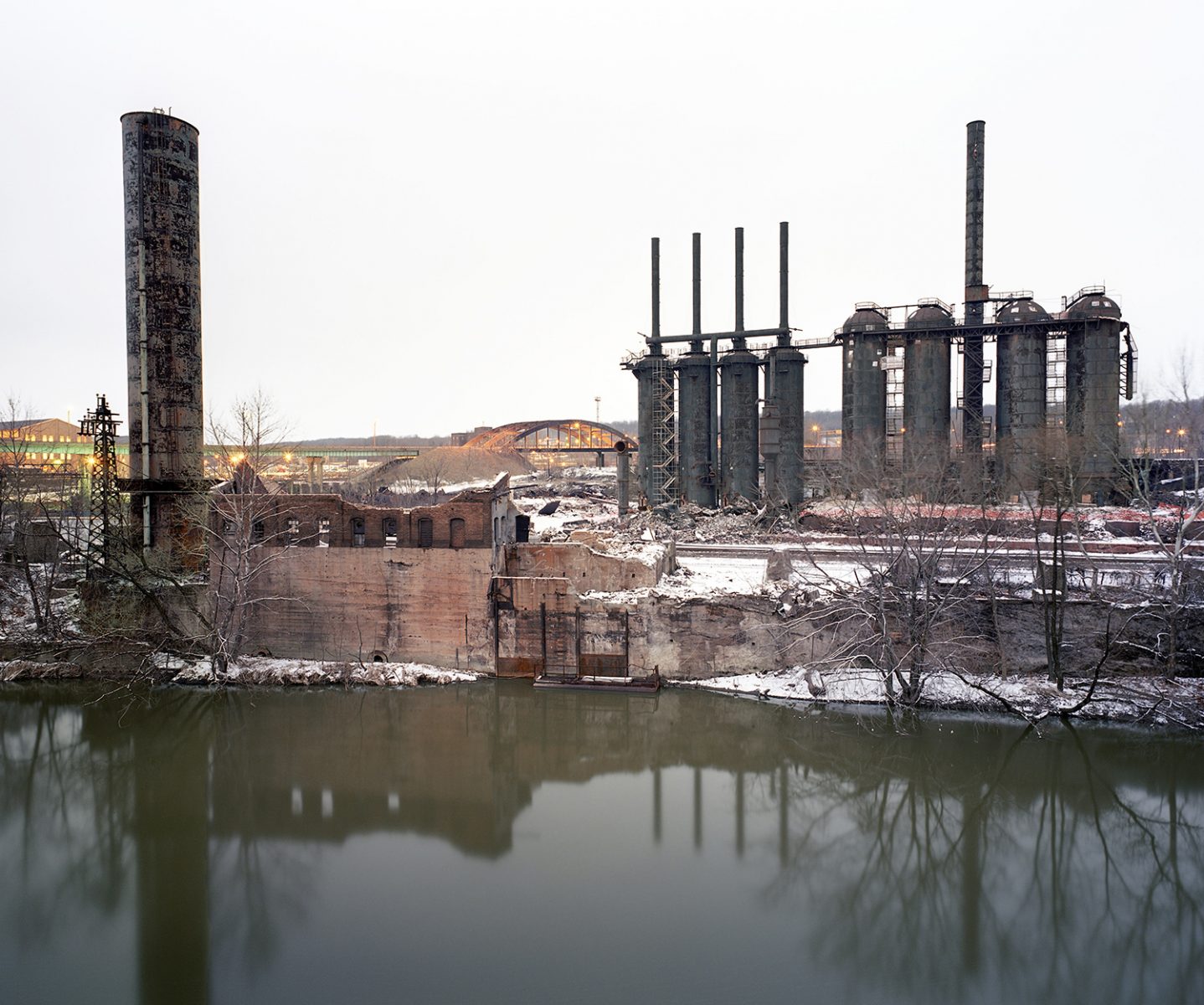
Johnstown, Pennsylvania, was one of the great American mill towns, folded into the mountains with the Bethlehem Steel works squeezed along the rivers and railroad tracks as though somebody had poured the mill into the valley and let it harden there. It was an enormous integrated steel operation in a place where geography seemed determined to make everything difficult. That didn’t stop anybody. Americans were very good at building enormous things in inconvenient places, particularly when there was money to be made.
Johnstown also had a history of being nearly destroyed by water. The great flood of 1889 killed more than 2,200 people, and another catastrophic flood came in 1977. Between the floods, the steel mills, the mountains and the people, you were getting into Butte territory. Both towns had been built around enormous industrial enterprises, and both developed their own culture, mythology, humor and peculiar forms of insanity.
When I went to Butte, I knew exactly why I was there. I went to photograph the place before it disappeared, beginning in the 1980s and returning through 1998. Johnstown was different because I already had a life there.
My best friend Ray’s father had left Johnstown for Cleveland in the 1940s, when Bethlehem Steel was still going strong. He wasn’t escaping a dying steel town. He went to work for General Motors, became a union man and settled into the automobile business. But the family never bought a house in Cleveland because they were always going back to Johnstown. This temporary arrangement lasted for decades, which is a fairly long time to be living somewhere you don’t intend to stay.
The relatives were still in Johnstown, and the family kept returning. It was like an Irish family immigrating to America and spending the rest of its life going back to the old country. Except the old country was Johnstown, Pennsylvania, and the trip didn’t require an ocean liner. I went along often enough that it became part of my own life.
Ray’s father was also a bookie. He had developed a good part of that skill in Cleveland, and when he finally retired to Johnstown, he resumed doing what he knew best. There was no shortage of customers. Johnstown had bars, ethnic social clubs, workingmen with paychecks, and enough people convinced they knew who was going to win Sunday’s football game to support a thriving little economy of its own.
When we were teenagers, we would pick up packages in one neighborhood and deliver them to another. It was quite an operation, and naturally this required visiting bars and social clubs throughout the city. Some people learn the geography of a town by studying a map. I learned Johnstown by following a bookie.
There was Jerry’s Bar, the Boomerang Club, Coney Island, Carl’s All American Bar, and the little joints in Franklin and Woodvale. There were clubs founded by immigrants who had come from all over Europe and somehow ended up in the same valley making American steel. Each place had its own memberships, customs, loyalties and arguments. The ethnic differences could survive several generations, even after everybody’s grandchildren had become Americans and were driving Chevrolets.
At the bar somebody knew whose shift had been cut, whose kid was in trouble, who owed money, who had a cousin working at the mill and who had been drinking since breakfast. Somebody would come in and buy a round, somebody else would start an argument about the Steelers, and a third fellow at the far end of the bar would explain exactly what was wrong with the country. He had usually been explaining it for twenty years, without much evidence that the country was listening.
Almost every bar in Johnstown in the 1980s seemed to have a portrait of John F. Kennedy hanging somewhere behind the bar. Kennedy had come through town campaigning for president, and the memory stuck. Presidents came and went, steel companies changed hands, furnaces shut down, but Kennedy stayed on the wall. In Johnstown, even his first name seemed appropriate.
Ray’s father made his rounds through the bars and clubs. His wife traveled a different circuit through church functions, parish dinners, weddings, wakes and community events. Between them, they knew half the town. He knew who owed somebody money; she knew who needed a casserole. It was a reasonably complete social system, and unlike most modern systems, the people involved actually knew one another.
And this was what I was photographing.
The maddening part is that I was there when the steel industry was collapsing. I was around when the blast furnaces were being shut down, and the works could still look operational because machinery was moving and portions of the plant continued functioning. Bethlehem Steel was sitting right there during one of the great industrial transformations in American history, and I did not photograph the fucking mill the way I should have.
But I wasn’t thinking about steel. I wasn’t choosing people over industry as part of some grand artistic theory. I was with my friends. I was inside the family, the bars, the clubs, the neighborhoods and the daily routines. The mill was simply there, so enormous and familiar that it became part of the scenery.
That was what struck me watching Slap Shot. Nancy Dowd had drawn the story from circumstances her brother knew playing for the Johnstown Jets, and the hockey, the bars, the language, the economic panic and the lunacy all felt lived-in because they were. In one scene, Paul Newman walks past the mill with the blast furnace working in the background, and somebody tells him the plant is closing and thousands of people will be out of work.
Nobody stops to explain the mill. Nobody in Johnstown needed it explained. It was there, right in the middle of everybody’s life.
And that was exactly my problem. It had been there for me too.
I have spent decades photographing industrial places, sometimes from the inside, sometimes from the outside, usually after considerable effort to get past the people whose job it was to keep people like me out. I knew what was happening to American industry. I knew opportunities were disappearing, and I knew the photographs would eventually become evidence of a world that no longer existed.
Yet in Johnstown I was practically a member of the family, with access to a world no visitor could simply walk into. I could photograph people in their kitchens, at their tables, in their bars and social clubs, people who had known one another for fifty years and had no particular reason to regard the fellow with the camera as anything unusual.
There was nothing especially noble about it. I was living my life. The pictures came out of it.
The same thing had happened in Williamsburg, Brooklyn, where I lived and worked inside an industrial neighborhood before much of it disappeared. It happened on 42nd Street and in Times Square, in Cleveland, the Forgotten Triangle and Chicago. I was involved with these places because they interested me, because I knew people there, because I had some connection to what was happening. It was never primarily an approach to photography. It was an approach to life, and the photographs were what I brought home.
A steel mill made more than steel. It made houses, taverns, churches, social clubs, Little League teams, weddings, arguments, paychecks, Christmas presents, retirements, bookies and families that stayed in the same valley for generations. The mill did not stop at the factory gate. The factory gate was where it started.
When the mill went away, the consequences weren’t confined to the men whose names appeared on the unemployment rolls. The tavern lost customers. The stores lost business. Families moved away. Membership declined at the clubs. The next generation decided there wasn’t much reason to remain in a place where the principal attraction had been dismantled and sold for scrap.
Some towns became shorthand for collapse: Gary, parts of South Chicago, Braddock. You could drive through them and see what happened when the economic machinery underneath a town was ripped out. Empty storefronts, abandoned houses, vacant lots and all the familiar scenery of American deindustrialization. Economists had numbers for these things. The people who lived there had a more immediate understanding. They looked out the window.
But there was something about steel towns that made their disappearance particularly striking. A steel mill wasn’t an ordinary factory producing an ordinary consumer product. It was a goddamn American icon. You didn’t merely work there. You entered it. The place was deafening, filthy, hot, smoky, dangerous and physical. You could smell it and hear it and feel it in your chest. There was nothing virtual about a blast furnace.
Someone once told me I photographed blast furnaces as though I were a blast furnace. I understood what he meant. I wasn’t standing around admiring an interesting industrial structure. I was responding to something I felt connected to.
There is a problem with photographing places like that. Beauty can lie. Arrange the smoke, light, color and structure too well and you can anesthetize the very thing you’re trying to describe. A rotten place can become gorgeous, and suddenly the picture is being admired for qualities that make the underlying reality disappear.
I have made the black-and-white pictures too, dirty, gray, hard and direct, but I’ve never believed there is only one legitimate way to photograph industry. I use whatever the subject gives me. If I photograph a blast furnace dramatically in color, it isn’t because I’m trying to prettify the thing. It’s because that’s what I saw and felt standing there.
The people who lived in these towns weren’t fools. They knew the pollution existed. They could see it coming out of the stacks, smell it in the air and wipe it off their windowsills. They also knew what the mills provided, and those two things could exist in the same person’s head without producing a philosophical crisis.
I knew plenty of old mill people who had worked in those places for decades and lived into their eighties and nineties. That doesn’t prove the pollution was harmless, because it wasn’t. It simply complicates the convenient story in which everybody living near heavy industry was waiting to be rescued from it.
I’m seventy-four and have cancer myself. I spent much of my life in Brooklyn, including years in one of its heavily polluted industrial neighborhoods. I watched people around me die from one disease or another. I don’t pretend that my experience establishes the medical history of an entire community, but it has made me suspicious of people who explain complicated human lives with a few statistics and a tidy conclusion.
People loved these towns despite knowing exactly what the mills were, and sometimes because of what the mills were. The work was dangerous and often miserable, but it mattered. The mill gave the town an identity. It was the thing over the hill, down the street, across the river and in everybody’s conversation.
And eventually it was gone.
The photographs I made in Johnstown coincided almost exactly with its decline as a great steel town. I kept returning for years, eventually winding down as the family grew older and the old reasons for making the trip began disappearing. There was a fiftieth wedding anniversary, another gathering of the people whose lives had carried me back and forth between Cleveland and Johnstown.
Then Ray’s father died. My own parents died in 2010, and the family circuit that had brought me to Johnstown for decades was ending. So were the photographs.
Most of the people in those pictures are dead now. The bars and clubs have changed or disappeared, and the great industrial organism that once filled the valley is largely gone. Johnstown’s population has fallen to a fraction of what it was when Bethlehem Steel was one of the great enterprises in American industry.
I would still like to go back, although I have a fairly good idea what I would find. I have been photographing and living in industrial towns and cities since 1977, and I’ve seen the same transformation repeatedly. The smoke disappears, the noise disappears, the machinery is dismantled, and eventually the old plants become empty fields.
Sometimes a building survives by itself with nothing around it anymore. Sometimes a piece of railroad ends in weeds. Sometimes there is a river where an enormous mill used to stand. The place becomes clean, but not suburban clean or new clean. Dirty clean. The industrial grime has largely disappeared, but the scars remain, and you can still tell that something enormous once happened there.
So this is my version of The Lost Bethlehem Steel Mill.
The mill itself is mostly missing from the photographs, and professionally that still bothers me. I knew better. I understood the importance of what was disappearing, and I had an opportunity that will never come again.
But what I did photograph was Ray’s family, their friends, the bookies, the bars, the social clubs and the people whose lives had been made possible, directly or indirectly, by the steelworks sitting in that valley. I photographed them from the inside, while the world they knew was still alive.
Now I can look at those photographs and see people who are no longer here, occupying rooms that have changed or vanished, having another drink, arguing about football, celebrating an anniversary, making a joke or simply sitting there being themselves.
The professional in me still thinks I should have photographed the goddamn steel mill.
The other part of me looks at the pictures and wonders what could possibly have been more important.
That is the argument I can’t settle. Maybe I don’t have to.