
The Rise and Fall of the NFT
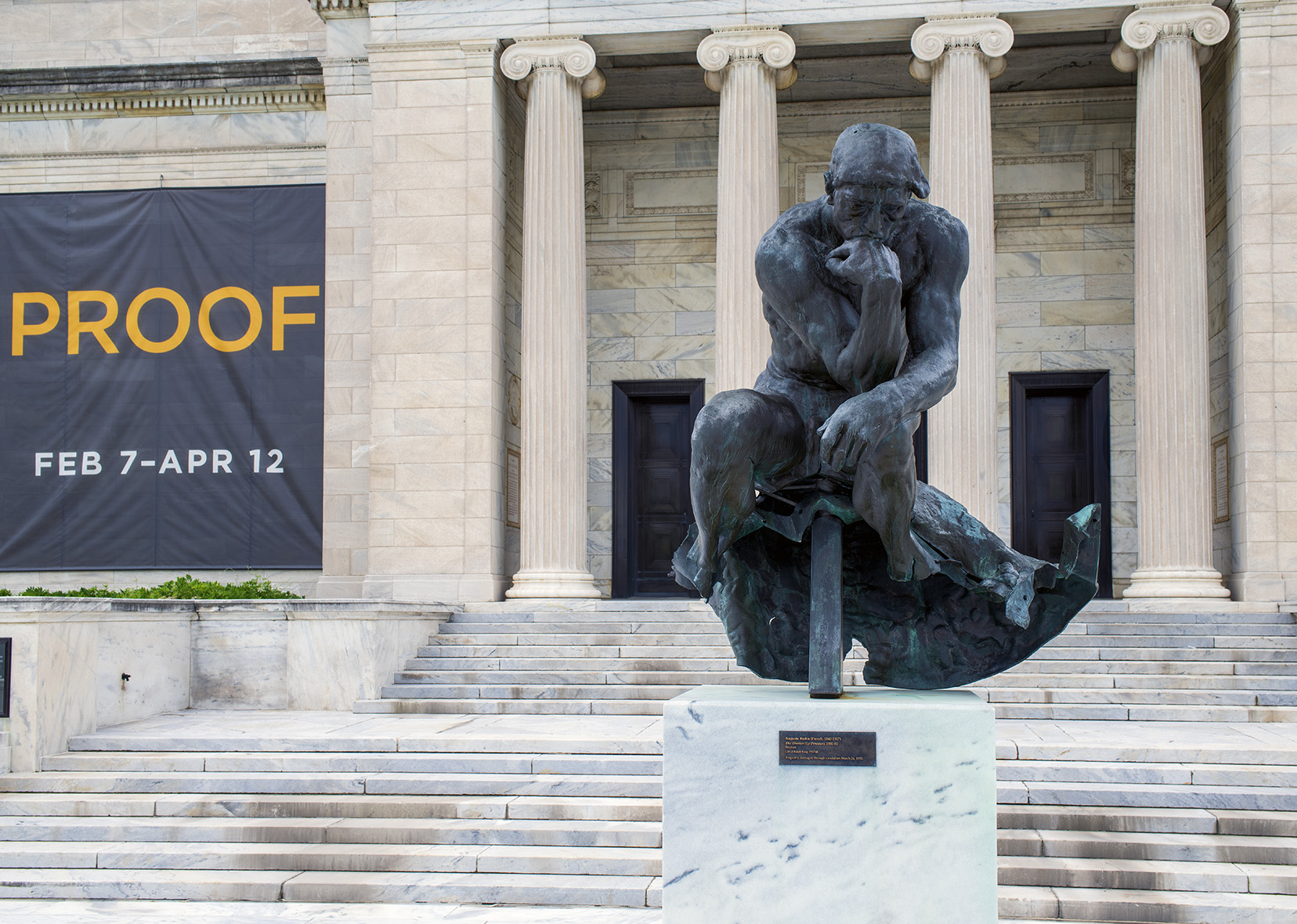
Outside of the Cleveland Museum of Art in 2020, Rodin’s the Thinker stands its ground. The work of our became a documented itself after it was blown off its pedestal in a bombing in 1970. Much to the credit of the museum the damage at the base of the statue was left as it is.
For a brief period in American history, people paid millions of dollars for pictures of cartoon monkeys. Not original paintings. Not rare photographs. Not even the exclusive right to reproduce the pictures. They paid fortunes for digital certificates associated with images anybody could look at for free.
The astonishing thing wasn’t that somebody dreamed up the racket. America has never suffered a shortage of hustlers. The astonishing thing was how many rich, famous, supposedly intelligent people took it seriously.
Remember NFTs? Apparently nobody does. A few years ago, they were being celebrated as the future of art, finance, and digital ownership. Now the whole business has practically vanished from public conversation, as though millions of dollars had disappeared down a sewer and everybody agreed not to mention the smell.
NFTs belonged to a growing collection of digital industries built around a wonderful economic discovery: you could manufacture a market for something with little or no underlying value, persuade people that the price itself established its worth, and make a fortune before anybody figured out what the hell they had bought.
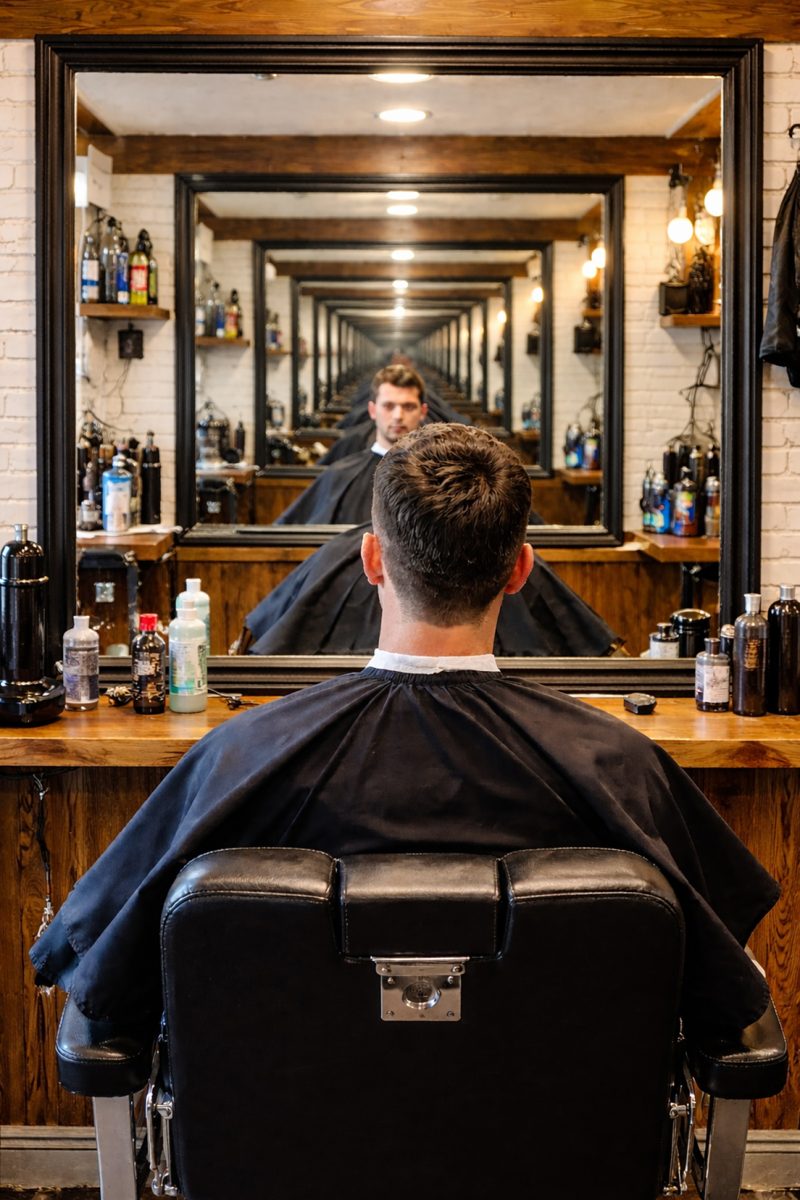
The big nothing of the recursive image is its infinite regression
Donald Trump’s cryptocurrency coins belong to the same speculative culture. The product is incidental. The speculation is the product. No factory, no assembly line, no merchandise to ship, nothing particularly useful to accomplish. Just a computer, a sales pitch, and enough people convinced that the next fool will pay more than the last one.
The NFT boom flourished during COVID, when people were dying, businesses were closing, and millions were sitting home staring at computers. While the world was going to hell, the hustlers found another way to separate people from their money. This time, they didn’t even have to manufacture a physical product.
An NFT, or non-fungible token, was a digital certificate recorded on a blockchain, usually associated with a picture anybody could download, copy, or hang over the toilet. The buyer didn’t necessarily acquire the copyright or exclusive rights to the image. He owned a token. Some of these things sold for millions, which tells you considerably more about the buyers than the pictures.
Photographers already had a way of selling rights to their work. It was called a licensing agreement. It established who could use a photograph, where, for how long, and for what price. An enforceable contract. The NFT promoters arrived promising to reinvent digital ownership and frequently sold certificates conveying none of those rights. They’d taken a functioning business arrangement, removed the useful part, and charged a fortune for what was left.
Progress, apparently.
Whenever an NFT promoter or executive was asked a simple question — What the hell am I actually buying? — the answer became an expedition through blockchains, smart contracts, decentralized ownership, digital scarcity, Web3, and the metaverse. By the time the explanation was finished, everybody had forgotten the question.
It sounded like an engineering convention locked in a room with a cocaine dealer and ordered to reinvent civilization. And that was part of the racket. If you didn’t understand it, perhaps you weren’t sophisticated enough to appreciate it. Ignorance had become a qualification for participation. They called it the democratization of art. Whenever somebody announces the democratization of something, look around and see who’s collecting the admission.
You couldn’t charge a quarter-million dollars for a cartoon monkey if you called it a cartoon monkey. But call it a non-fungible token, announce a limited supply, and suddenly the monkey becomes an investment. Scarcity creates value, they explained. So does a wart on your ass. There’s only one exactly like it. Try selling it.
And then came the celebrities.
Tom Brady co-founded an NFT company called Autograph while he and his then-wife, Gisele Bündchen, were promoting the cryptocurrency exchange FTX. Justin Bieber, Madonna, Paris Hilton, Snoop Dogg, Stephen Curry, Jimmy Fallon, and assorted other multimillionaires joined the digital gold rush. Fallon and Hilton actually sat on national television showing each other pictures of their expensive cartoon monkeys, like two children comparing baseball cards, except the baseball cards cost hundreds of thousands of dollars.
There they were, some of the most famous people in America, lending their names and fortunes to the proposition that a cartoon ape was valuable property. Nobody had invented a better washing machine, opened a factory, or discovered a cure for cancer. They’d manufactured electronic collectibles and surrounded them with celebrities, publicity, and enough financial terminology to make a shell game sound like an economics seminar.
The celebrities supplied credibility. If Tom Brady was involved, if Paris Hilton was buying, if Jimmy Fallon was showing off his monkey on television, surely they knew something the rest of us didn’t. Of course, being able to throw a football or host a television program doesn’t qualify somebody to explain the economic value of a digital certificate. But nobody was paying them to explain anything. They were there to make the merchandise respectable.
The pandemic supplied the audience, cryptocurrency supplied the speculators, and venture capital supplied the money. Prices rose because prices were rising. Every new sucker made the previous sucker look brilliant. If you got out in time, you were a visionary. If you didn’t, you were a long-term investor.
The art establishment already understood the arrangement. Galleries, curators, collectors, elaborate theories, and the proper people standing around nodding at one another had been manufacturing value for years. The NFT promoters simply removed the furniture. No paintings to transport, no sculptures to store, no inconvenient objects whatsoever. The blockchain supplied scarcity, the market supplied the price, and the experts supplied the bullshit.
The old art-world racket, stripped down to its underwear and connected to the internet.
The significance of the NFT craze goes beyond the fortunes made and lost. Here was a moment when common sense, ordinary judgment, and the distinction between price and value were being publicly dismantled. Something that would have been laughed out of a neighborhood bar was being celebrated by auction houses, financial journalists, and investment firms as the beginning of a new economic era.
Then the market collapsed. Not entirely, but enough to render enormous quantities of once-expensive digital property nearly worthless. The celebrities went quiet, the prophets found new prophecies, and the monkeys remained exactly as they were. When a monkey lost ninety percent of its value, it didn’t look ninety percent worse. It looked exactly as stupid as it had before.
The celebrities still had their mansions. The customers had their monkeys.
Nothing had changed except the ownership of the money.
And then everybody forgot. An entire speculative industry appeared, collected fortunes, left thousands of people holding nearly worthless merchandise, and wandered off without so much as an embarrassed cough.
How many times does this have to happen before somebody notices the pattern? Invent a market, manufacture excitement, promise tomorrow, collect today’s money, and leave the late arrivals to discover what yesterday’s promises are worth.
Not every cryptocurrency is worthless, nor is every promoter a crook. But when the principal attraction of a product is the expectation that somebody else will pay more for it tomorrow, the distinction between investment and gambling becomes uncomfortably small.
A photograph begins somewhere else. I’ve spent much of my life photographing people, factories, bars, streets, and the disappearing American industrial city. The people were there. The steel was there. When the buildings came down, the photographs remained. They are artifacts of experience. The experience came first.
The NFT business had it backward. The certificate came first, the value was announced, and reality was expected to follow. What buyers acquired was often little more than the digital equivalent of a receipt. And a receipt proves a transaction, not value, much less truth.
But something larger was happening. The NFT promoters had demonstrated how easily a price could be manufactured and mistaken for value. All it required was publicity, repetition, and enough people willing to believe. Once the crowd accepted the proposition, the price became its own evidence. It was valuable because people said it was valuable, and people believed it was valuable because somebody had put a price on it.
The same trick works outside the marketplace. Substitute a political claim for a digital monkey, replace the auction with a television audience, and the machinery is remarkably similar. Repeat something often enough, surround it with the right personalities, and the number of believers begins to substitute for the evidence.
Donald Trump demonstrated how far that process could be carried. Claims contradicted by documented facts could acquire a life of their own through repetition and loyalty. Millions accepted the performance as fact. The point wasn’t necessarily to make the story more convincing. It was to make the audience less interested in whether it was true.
The NFT promoter wanted you to believe his certificate had value. The political salesman wanted you to believe his version of events. Neither needed reality to cooperate as long as the audience did.
Now the machines have arrived, and the proposition has become considerably more dangerous. Artificial intelligence doesn’t merely help manufacture belief. It can manufacture the evidence that belief once required. Photographs can be altered, voices manufactured, events invented, and people placed in situations that never occurred. A lie no longer needs a witness when a convincing imitation can be produced on demand.
Reality hasn’t disappeared. The factories existed. The streets existed. The people were there. But our ability to establish what happened, what existed, and who was present is increasingly under assault.
The NFT salesmen manufactured scarcity where none was needed. The new machinery manufactures abundance where none existed: an infinity of pictures, voices, witnesses, histories, and lies, each generation feeding the next, until the original disappears beneath its own reproductions. And the real thing? Somewhere in the pile, indistinguishable to anyone who wasn’t there.
We’ve gone from selling certificates of authenticity for pictures nobody needed to authenticating a world in which anything can be made to appear real.
The world is still there. The question is whether anybody will be able to prove it.
IF YOU KNOW THE TERRITORY
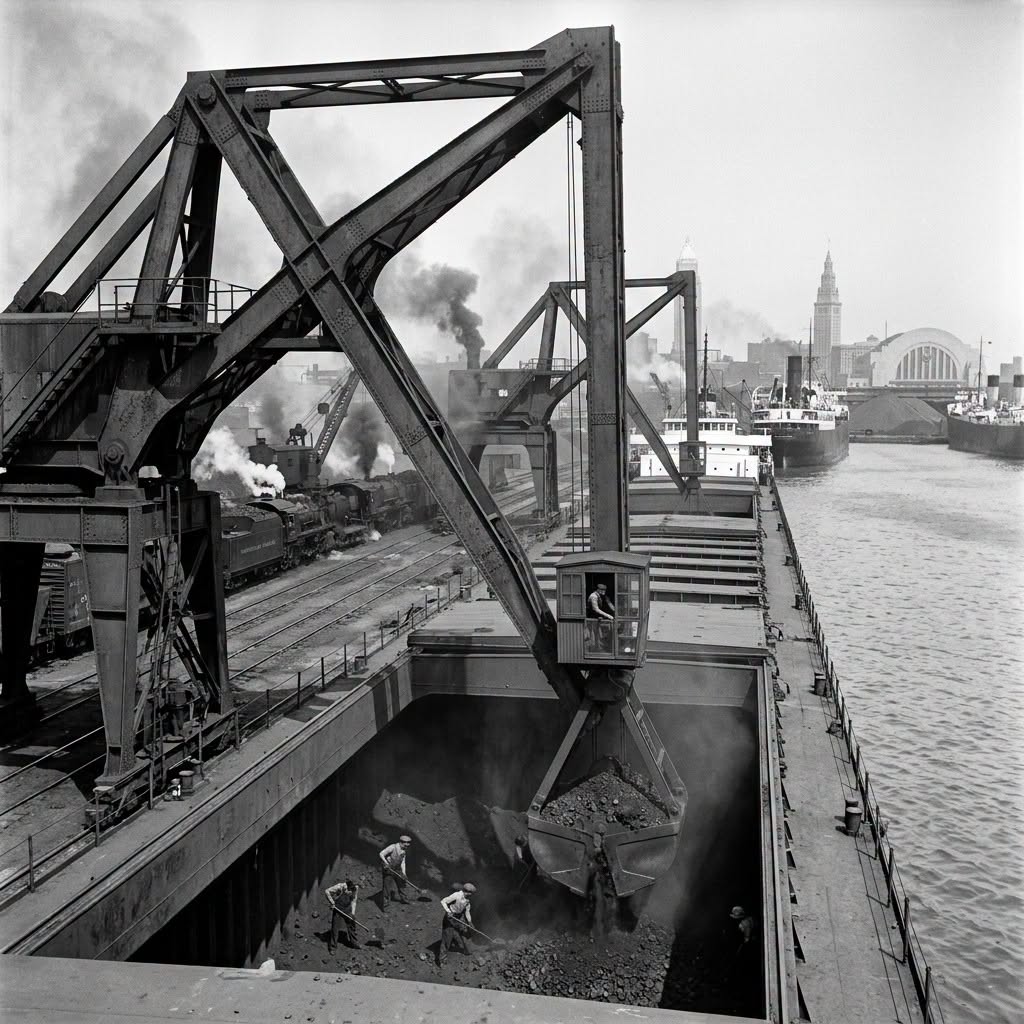
I’ve been photographing America’s steel towns and industrial cities since 1977. Cleveland has been one of my principal subjects, including its magnificent, now-demolished Hulett iron ore unloaders.
The picture above is a pretty convincing piece, not the usual ultra-dramatic exaggerated AI slop. Convincing, that is, if you don’t know what the hell you’re looking at.
That’s no Hulett unloader. The real machines had enormous articulated legs and clamshell buckets that reached into the holds of ore boats. Front-end loaders would then be lowered into the ships’ holds to clean out the remaining ore.
And there’s Cleveland’s Terminal Tower in the distance. Except somebody parked Cincinnati’s Union Terminal beside it, 250 miles from home. Two cities, two histories, one imaginary waterfront.
The machinery looks authentic. The smoke looks authentic. Even the men shoveling ore look authentic. It’s a terrific photograph of something that never happened.
I’ve spent nearly fifty years photographing these places, their mills, machinery, workers, neighborhoods, and eventual disappearance. I was there. The buildings were there. The photographs are evidence of that experience. AI can now manufacture a more spectacular history in seconds, complete with machinery that never existed and buildings that never belonged together.
Does any of this matter?
Only if you know the territory. Experienced it. Shot it.
A TRANSLATION FOR OUR BLUE-COLLAR READERS MOST OF WHOM DON’T READ ANYMORE IN A POST-LITERATE WORLD:
BAUDRILLARD WALKS INTO A BAR:
An Encounter with Jimmy Breslin
Jean Baudrillard walked into a bar on the Lower East Side at three in the afternoon, ordered a glass of red wine, and sat down beside Jimmy Breslin, who was drinking whiskey and studying the racing results. Breslin glanced at the Frenchman’s expensive jacket, his solemn expression, and the glass of wine.
“You’re in the wrong joint, pal.”
“On the contrary,” Baudrillard replied. “I’m interested in the disappearance of reality.”
“Then you’re in the right joint.”
The Frenchman began explaining that modern civilization had entered an age of simulation, in which representations no longer reflected reality but replaced it. Images referred to other images, symbols acquired value independently of the objects they represented, and the original eventually disappeared beneath an endless accumulation of copies. Breslin listened for a while, folded his newspaper, and asked how much a man got paid for talking like that.
Baudrillard appeared puzzled. “Talking like what?”
“Like somebody swallowed a dictionary and couldn’t get it back up.”
The Frenchman was accustomed to intellectual resistance, although generally from people who had read his books. He offered an example. Suppose a man purchased a digital image of a cartoon monkey for a million dollars. The object had no physical existence, yet its value was established through a system of signs and the collective belief that those signs represented something worth owning.
“You mean those fucking monkeys?” Breslin asked. Baudrillard nodded and explained that the buyer actually owned a token representing ownership within a decentralized system of symbolic exchange.
“So a guy pays a million bucks for a monkey he can’t hang on his wall, everybody else can look at it for nothing, and what he gets is a token?”
“Precisely.”
Breslin turned toward the bartender. “Frank, you hear this? Some asshole paid a million dollars for a monkey, and they didn’t even give him the monkey.”
Frank was polishing a glass that hadn’t been clean in twenty years. He considered the proposition before answering. “That’s not bad. Usually you gotta give the guy something.”
Baudrillard attempted to clarify matters. Modern society, he explained, had learned to manufacture desire independently of material necessity. People increasingly purchased objects not for their usefulness but for the meanings attached to them. The symbol had become more important than the thing itself.
“That’s advertising,” Breslin observed.
“But these signs reproduce themselves indefinitely, without reference to an original.”
“That’s television.”
“Eventually society becomes incapable of distinguishing simulation from reality.”
“That’s politics.”
Baudrillard stopped talking and regarded the newspaperman with renewed interest. He asked whether Breslin had read any of his work.
“Never heard of you.”
The Frenchman returned to his wine while Breslin resumed studying the racing results. A horse named Honest Money was running at Belmont, having lost its previous six races and somehow emerged as the favorite. Breslin considered this a more interesting example of manufactured belief than anything the professor had mentioned. At least the horse existed, although judging by its record, it hadn’t shown much interest in running.
Baudrillard, however, wasn’t finished. He wanted to know what would happen when machines could manufacture photographs, voices, historical events, and even human beings who had never existed. What would become of truth when every image could be reproduced, altered, and replaced until nobody could establish what had originally been there?
Breslin glanced toward the television above the bar, where a billionaire was explaining why ordinary Americans ought to invest in something called the future.
“Same thing that always happens,” he said. “The guy with the money tells the story, and the guy without the money gets stuck living with it.”
“But how will we establish what is real?” Baudrillard insisted.
Breslin reached into his pocket, placed a twenty-dollar bill on the bar, and told Frank to give the professor another glass of wine. Baudrillard examined the money as though Breslin had produced an archaeological discovery and asked what it was supposed to demonstrate.
“That’s twenty dollars. It was twenty dollars before I put it down, and it’ll be twenty dollars after Frank picks it up. Tomorrow his landlord is gonna want twelve hundred of them. You can explain to him that money is a system of signs, but I wouldn’t recommend it.”
Frank pocketed the bill. “He’s right. My landlord don’t give a shit about philosophy.”
For the first time that afternoon, Baudrillard appeared genuinely amused. Perhaps, he suggested, they were describing the same world from opposite directions. One approached reality through philosophy, the other through ordinary human experience. Their methods differed, but their conclusions were not necessarily incompatible.
“Sure,” Breslin said. “You tell people reality has disappeared. I go find out who stole it.”
“And what if there is no original reality left to recover?”
“Then somebody’s making a fortune selling the replacement.”
The bartender turned up the television. The billionaire was still talking, explaining that the future belonged to people who believed in it. Beneath his face, numbers moved across the screen, rising and falling with no apparent connection to anything taking place inside the bar. Baudrillard watched for a moment before turning back to Breslin.
“You know, Jimmy, in France we call this hyperreality.”
Breslin finished his whiskey. “In New York we call it bullshit.”
Frank nodded. He’d been listening to both men for half an hour and was beginning to wonder whether the Frenchman intended to pay for anything himself.
On television, the billionaire continued selling shares in the future. Nobody in the bar believed a word he was saying, not even Frank, who had once bought a racehorse with three other bartenders and spent two years paying its veterinarian.
The shares were going up anyway.