
Sundance Tree, Red Shirt Table, Poor Thunder Family Land
Oglala Lakota, Pine Ridge Reservation, 1998
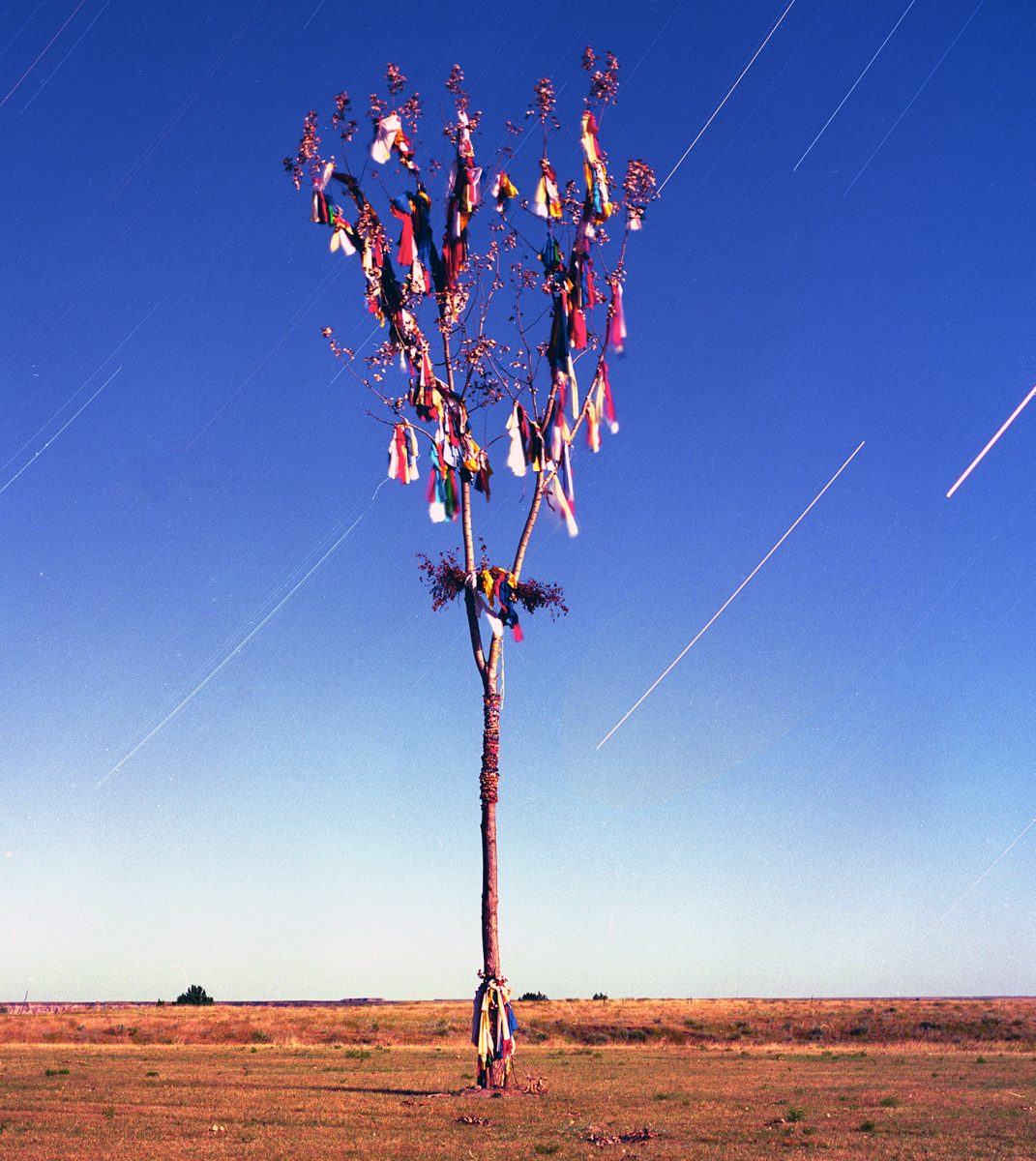
These shots are a small part of a seven-year journey through all the American Badlands, all of it photographed using moonlight. The work was organized around the full moon—the night before, the full moon itself and the night after—but it also depended on the progression of time from daylight through sunset and twilight into darkness. Twilight has long carried the idea of a threshold, the uncertain passage between one condition and another, and the Badlands were particularly good at making that transition visible. By moonlight, a long exposure recorded something else entirely. It did not merely show an object under dimmer light; during an hour the prayer cloths could move in the wind, the stars moved with the rotation of the earth, moonlight traveled across the objects, and shadows shifted, softened and feathered while the film continued gathering all of it.
On one trip that had nearly been washed out by torrential rain, some young Lakota at the Longhorn Saloon in Scenic began calling me Mako Sica Hoksila—Badlands Boy. I liked the name, but a name does not change who you are. I am not Lakota. I am wašíču, and whether it is right or wrong, my journey demanded that an artifact be brought back. Mine was the photograph. I don’t sell it. I keep it until there is a reason to show it and, when the time comes, a reason to give it.
The work itself could be brutal. On a working night I might carry thirty-five pounds of equipment for as much as seventeen miles—three cameras and three tripods so I could keep several long exposures working and continue moving through the country. There was no food and there was no water. Nothing spoke to me. I never hallucinated and I never went into a trance. I became exhausted enough that the unnecessary things began falling away, the country became very clear and my head became clearer with it. That was part of what I carried back into the wašíču world, which in my case happened to be New York City, a place not generally accused of clarity.
On this particular trip I was working on top of Sheep Mountain Table and then moving south and west into the Pine Ridge Reservation, through the country of Cuny Table, Stronghold Table and Red Shirt Table. Somewhere in that country I came upon the Sundance grounds on Poor Thunder family land at Red Shirt Table.
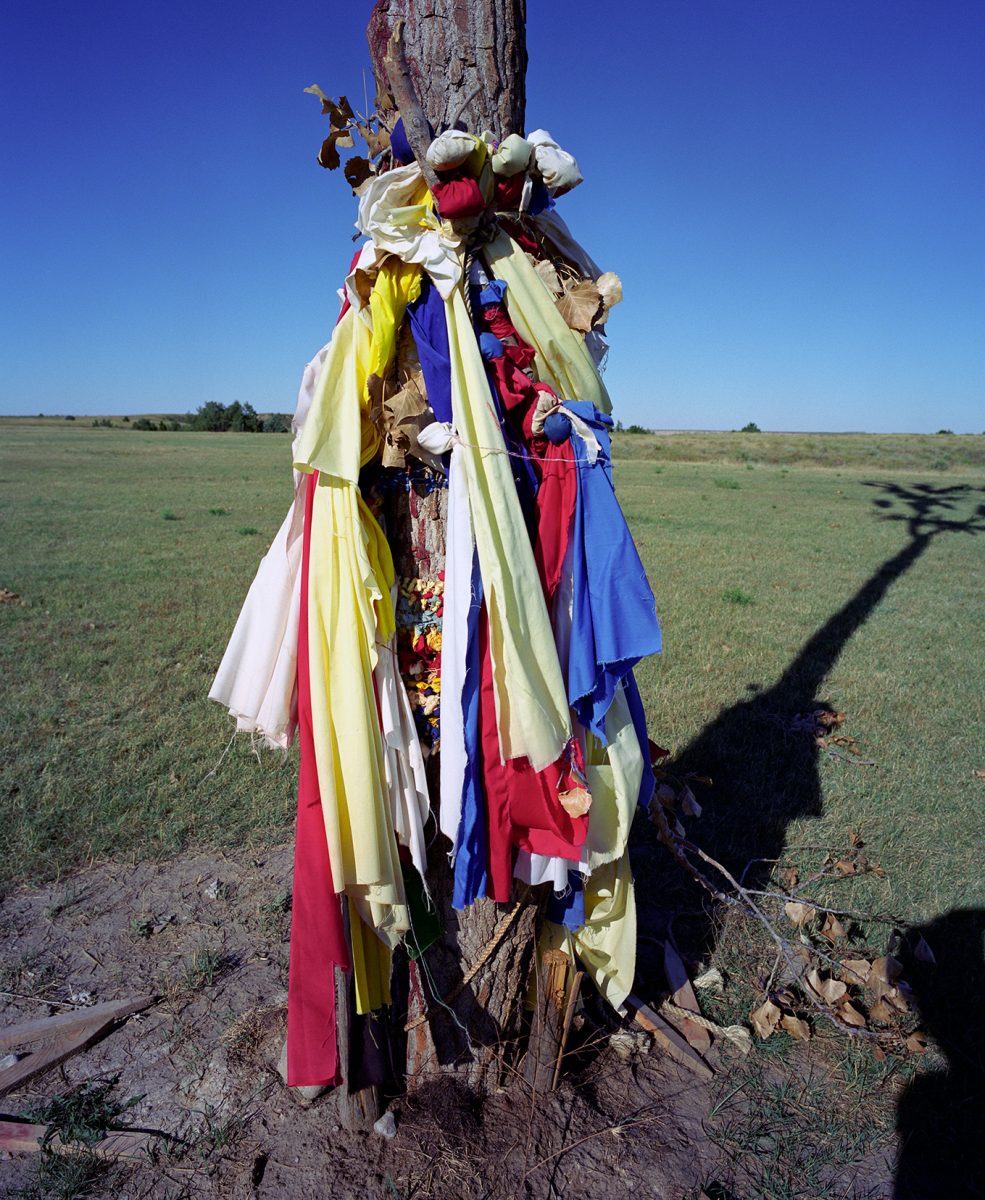
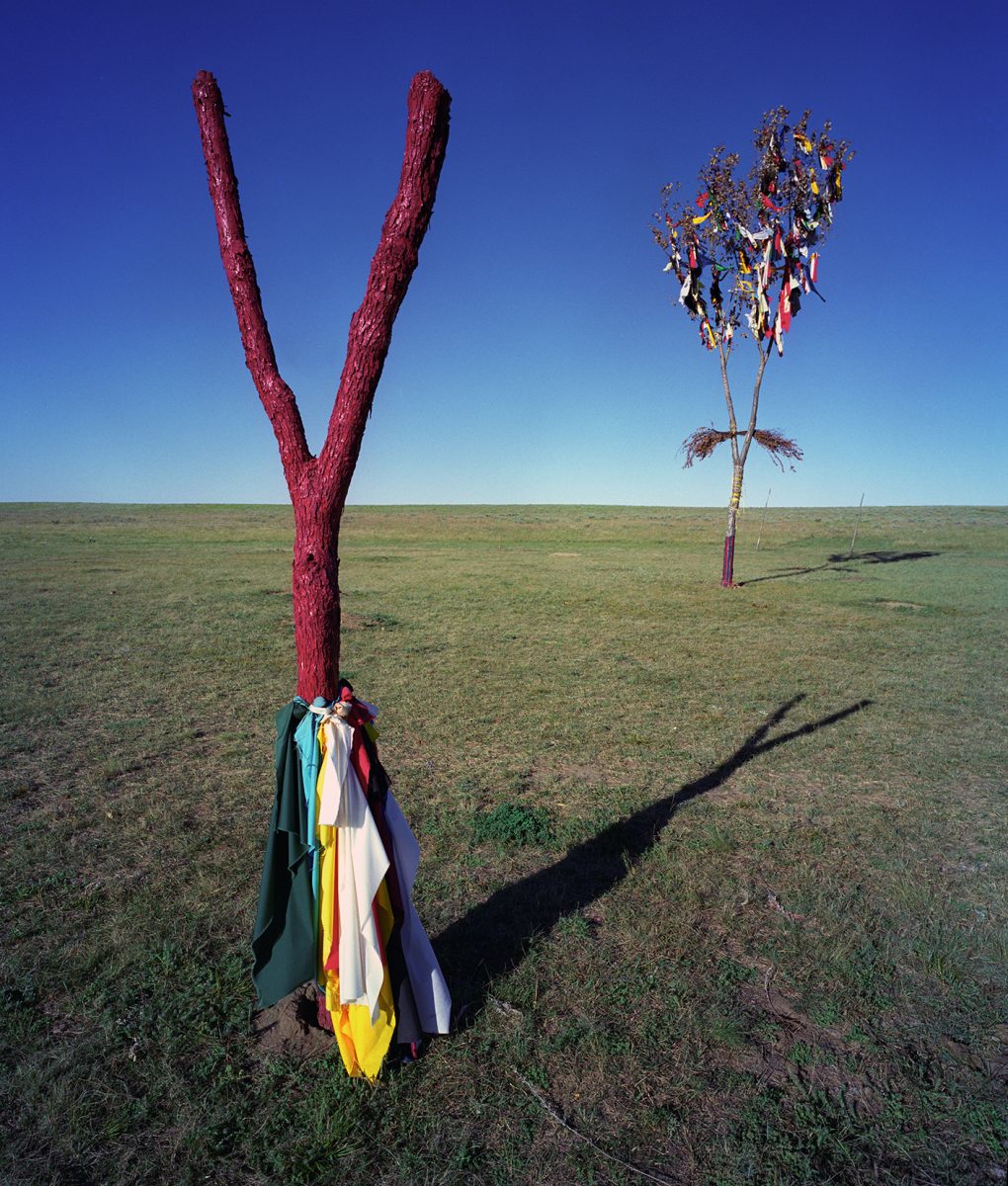
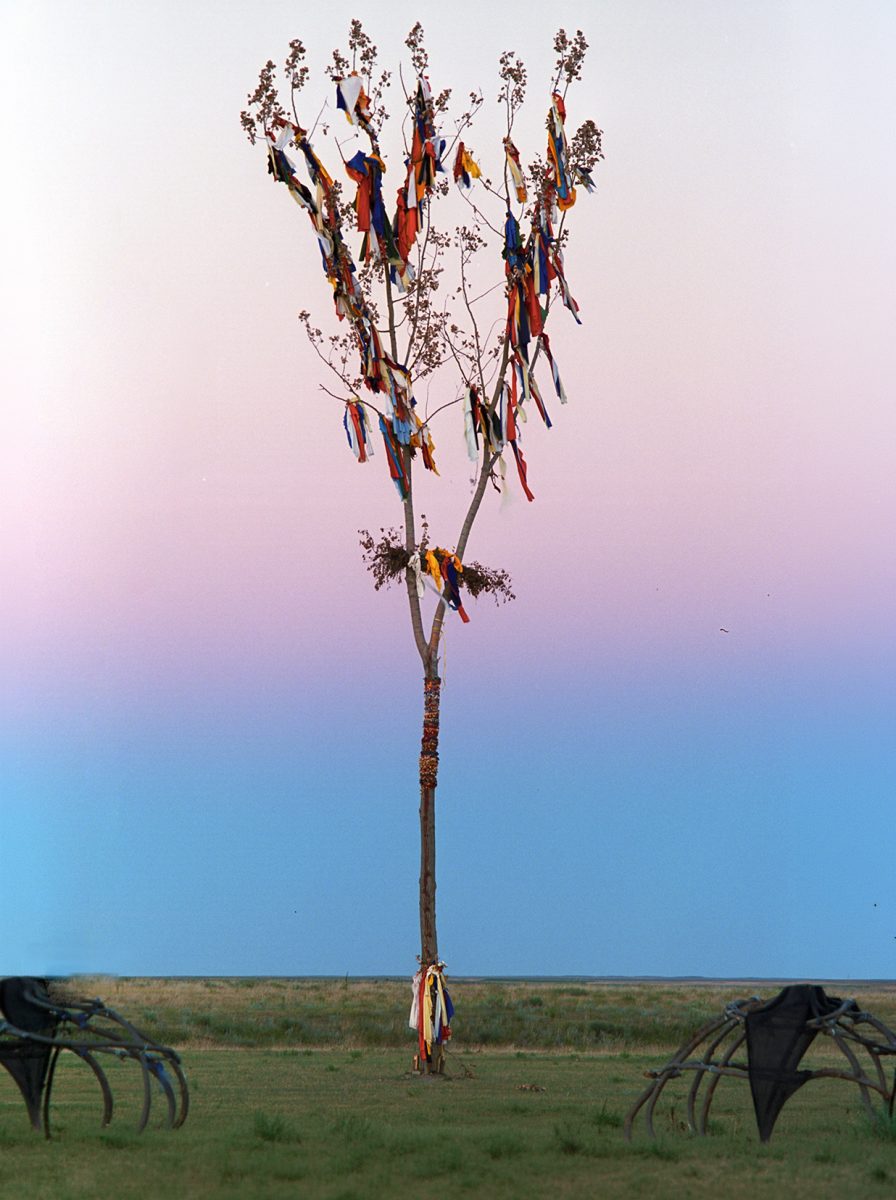
A lone cottonwood had been brought onto the prairie and driven into the earth, its trunk covered with prayer cloths. Around it stood the low bent frames of the Inipi, the sweat lodges used for purification, and beyond them the Badlands simply continued. Nothing was there for decoration. Nobody had put the tree there because the prairie needed improving. This was ceremonial ground.
The four shots follow the place through time. There is daylight, when everything is plainly visible; then the lowering sun and the lengthening shadows; then twilight, that narrow unsettled passage when the prairie darkens before the sky; and finally moonlight, when the human eye gives up much of what the film continues to collect. The Sundance Tree remains at the center while everything around it changes.
The tree stands at the center of the Sun Dance. A cottonwood is selected, cut, carried to the ceremonial ground and raised as the central pole. Sun Dance is prayer, sacrifice and endurance. Piercing may be part of that sacrifice, with dancers tethered to the tree and offering their own flesh as part of something larger than themselves. The point is not pain performed for anybody watching. What is sought and what is given belong not only to the individual but to the people.
The formal Lakota vision quest, Haŋbléčeyapi, is a separate ceremony, a person going alone without food or water to pray and seek knowledge, understanding and vision. That distinction matters. Lakota ceremonies have their own names, purposes and traditions; they do not need a wašíču writer tossing them together because the words sound good.
When I photographed the Red Shirt Table grounds in 1998, they were living ceremonial grounds. Years later, vandals entered the site and destroyed the ceremonial shades and the Inipi structures visible in these pictures. You can rebuild wood, but you cannot restore that particular moment. What began as four photographs of something present became a record of something entirely gone.
Time was already everywhere in the Badlands. The land itself is time exposed: layer after layer laid down, uncovered and worn away. Something that appears permanent is changing grain by grain every hour. Human time looks fairly small against it. Photography has the same argument built into it because every photograph, whether made in a thousandth of a second or an hour, is a piece of time pulled out of the flow and kept.
The last of these four shots was made entirely by moonlight, with an exposure of about an hour. During that hour the negative did not record one frozen instant. It accumulated what happened. The prayer cloths moved. The stars traveled across the film. Moonlight slowly crossed the tree and the structures around it, illuminating one surface and then another as the shadows changed position, softened at their edges and feathered into the exposure. What appears to be a still photograph contains an hour of movement.
Photography usually takes a fraction of a second and calls it time. This photograph did the opposite and accumulated it—moonlight, stars, wind, shadows, prairie and tree.
The camera took an hour for the last shot and these four shots waited twenty-eight years; now there’s a reason to show them. Torched by idiots, it’s gone and available to the Poor Thunder family. The time concentrated there in 1998 has become history, and an hour of it remains on the film: the stars moved, the shadows shifted and feathered, moonlight traveled across the tree, the Badlands kept wearing themselves away, and the Sundance Tree stood still.
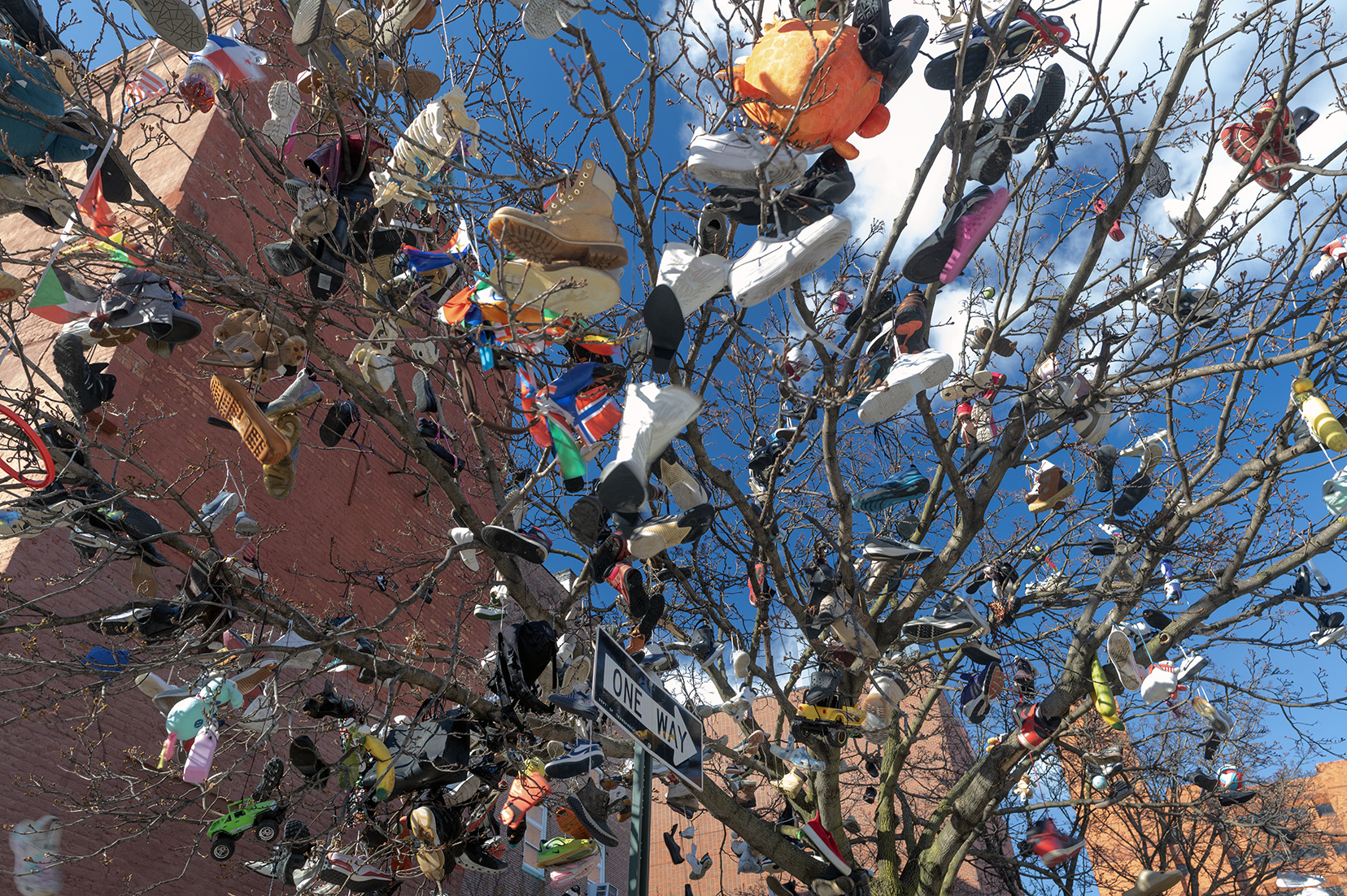
In Mott Haven, Bronx the Mother of All Shoe Toss Trees sits next to Lincoln Hospital, along East 143rd Street.