
TECHNICAL
Regardless, your ideas of nature, spirituality and highly unusual landscapes, i bring technical equipment, not camping gear, beverages, food or any device beyond my camera, into this environment, because the sole intention is a mission of pictures. I don’t lay on the earth and gaze at the stars in a bad land. I work and use equipment over big stretches of terrain, in constant movement at night in a rough wilderness. Constant movement, strain and struggle, with occasional moments of no work and possible meditation. But that doesn’t mean i don’t think, in fact, very much the contrary.
This is photography by moonlight and is shot on color negative film at the height of the Golden Age of Color Photography just prior to digital photography. Begun in 1994, the right color negative had finally been made, five years prior, for this sort of shooting. And the the finest medium format camera, was available with the best lenses with the least distortion as well.
I had been using this light source, off and on, fifteen years before this book, and i looked forward to a day when a film would be made to handle the extreme color shifts and radical reciprocity compensation that ultra-long exposures needed, unlike the ease of digital today. Ektar 25 was introduced in 1988, i finally had the film i needed for very low light and very long exposures. Miraculously it was also the highest resolution color film ever made, equalling Kodachrome 25 with the distinct advantage by virtue of being negative, you could filter the color shifts in post-production. After having shot with the moon since two years after I first started making pictures, in 1977, I got a hold of Ektar 25 and it rendered moonlit lands the best. It’s only downside was that, as color negative, it was not archival, but, at least, the film companies, through competition, had increased the longevity somewhat, right before film’s collapse and demise.
When the Mamiya 7 hit, combined with Ektar 25, it was time to make entire books that were moonlit. I was using the 35mm version since it first came out, then when it became available in 120 roll film and the best optics ever achieved in 6×7 cameras, the moon thing got more serious. I was finally armed correctly and state of the art, for the mission.
This is photography by essentially moonlight and is film, not digital. Although i had been using this light source fifteen years before this book. But I was shooting Kodachrome 25, a truly great film whose sole problem, a big one, was its uselessness in long exposures. This Bad Land, for myself and a profession, was a culmination of a long run looking for the right film to use with moonlight that demanded ultra-long exposures which was also what most film was never built to do. When Ektar 25 was introduced in 1988, i finally had the film i needed for low reciprocity, high resolution and color negative that handled color shifts, and the fact it was the most “difficult” of films for low light, let alone light this low, wasn’t considered. It’s quality overpowered that easily. Today digital would produce the same resolution at an exposure of 20 minutes and at the same ISO with no reciprocity, and easily correctible characteristics of long exposures, can be handled by computer. After using both systems extensively, digital is a dream come true as far as ease and money spent on film, processing and scanning amongst others. For instance batteries and cable releases that my Mamiya 7’s gobbled up for years.
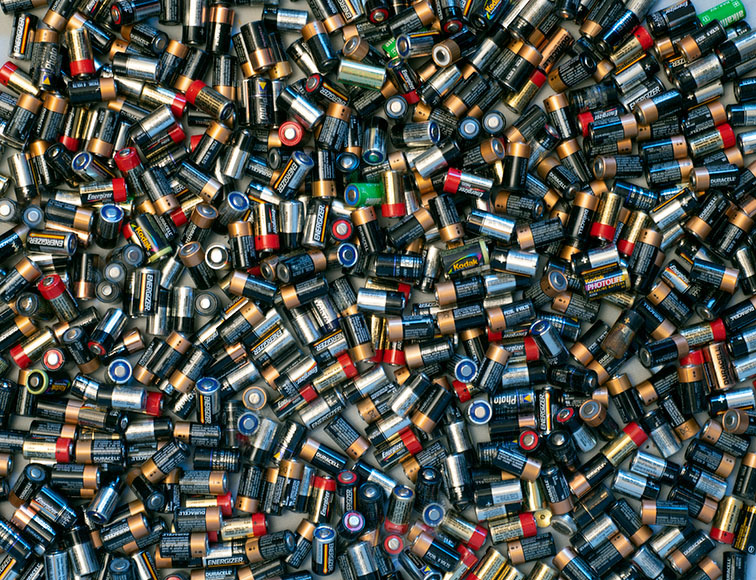
Six volt batteries, eight bucks a piece, using, conservatively, two a week and after fifteen years you’ve spent over 20,000. Nevertheless, as far as digital is concerned, the film camera I used, today is highly sought after as the gold standard in things like lens quality and lack of distortion. Very few film cameras are worth double their original price today, most are worth from nothing to a couple hundred at best, but the 6×7 film cameras used had the best image quality, in the Golden Age of Color Film.
I use only digital if i do any full moon work today, which, became a practice when digital made it easy and in vogue, and i have pulled back substantially. Looking through the web, digital has boosted the numbers of people doing this, but, back in the seventies through 2004 there was really no one. I use to reserve four days a month beginning forty years ago for this moon work, and that’s a hell of a commitment, and This Bad Land is a culmination of the years working the night shift, crafting moonlit shots that no one has seen, neither this book or any of my extensive output on night photography going back to the seventies which, if i have the misfortune of being around a photographer, always leads to problems, only reinforcing a purposely cultivated anonymity from my experience based being around art a few times, including media and entertainment types. By 1994 i finally got the time and resources to begin an exclusively moonlit landscape book on Ektar 25 film aimed at the American badlands.
FIRST CAMERA QUEST
Upon buying my first cameras – a 35mm Canonet rangefinder and a Canon super 8 film camera – and the South Dakota Badlands is where i headed. Before this book, the terrain wasn’t new to me, but it was a place it took me a long time in order to visit and work there, and, since, i never stop thinking about it. When i got my first camera in 1977, and, after living fully in the world in a blue-collar way, it’s there that i went, and when i got my first movie camera, i stole a trip out there again, never forgetting it, leaving its lasting impression on my mind. Finally by the early nineties the right set of circumstances occurred to free me, to pursue something kept on ice for almost twenty years – capture all of the American badlands at night with a full moon.
PICTURES QUEST
If i was performing an Indian ceremony, i wouldn’t be talking about it, out of respect. This was a book about the geography of a land that happened to be associated, at times, with the practices of Natives. This is a pictures mission, and not, at all, about, what became known as a vision quest. Nevertheless the book has not been seen until now, was completed in 2002 and remained in the archive.
Vision quest is probably an English umbrella term for youth, landscapes and self-discovery or prophecy. The American Indian has come to define the term with both negative and positive consequences. The flipping, reinvention and coopting of Native ceremonies is a disaster, of course, and has been directly addressed by the Indians themselves in the 1993 Declaration of War Against Exploiters of Lakota Spirituality http://www.thepeoplespaths.net/articles/ladecwar.htm
I was on a mission and quest, no doubt, and it was pictures, which are solid visions, they exist and the moon lets us see them at night. The process or job itself of being in the world and capturing views, is the same as, gambling, hunting, farming and weather prediction. There is a target, capture and trophy, the negative, as well as the artifact of pictures, but i actually take nothing from the landscape but an image, that respects the land, experiences it fully and explains it visually.
LIFE IS RARE
The lifelessness here mimics that of another planet, but it’s still our planet, and a reminder we could end up like this. All of us, one day, surely, will be lifeless, and things out here always made me feel lucky for the life but cannot stop from disappearing.
I ran into the bristlecone pine during this badland run, and it, too, was a reminder of the motivations for being here, and in too many other forgotten places in the cities to the east.
The tree is synonymous with high desert badlands, which themselves are rare, and appeared at Bryce Canyon and Cedar Bluffs during the shooting of this book.

Small, unhealthy bristlecone pines inside Bryce Canyon.
On the earth’s surface, the most timeless living things are the bristlecone pines, whose strategy for survival for the long-term is going where no other plants, insect, bacteria, parasites and few fungi can live. Its isolation above the tree line on dry rocky surfaces where no other living things care to go, translates into a very long life. A dense wood, its rings are tight and many and will desiccate sections of itself to live longer. It’s the ultimate land-dwelling survivalist.
The bristlecone pine is another big reminder and lesson in reclusion as a strategy for protection, production and survival, and a formation reaction as good as any in the unliving geology of the badlands. Yeah, I was here to take pictures, but knew, of course, why I chose this, and the bristlecone pine, a rare living tree, in a bad land, physically answered that, and it’s form and substance is a reaction and absorption to its unusual environment.
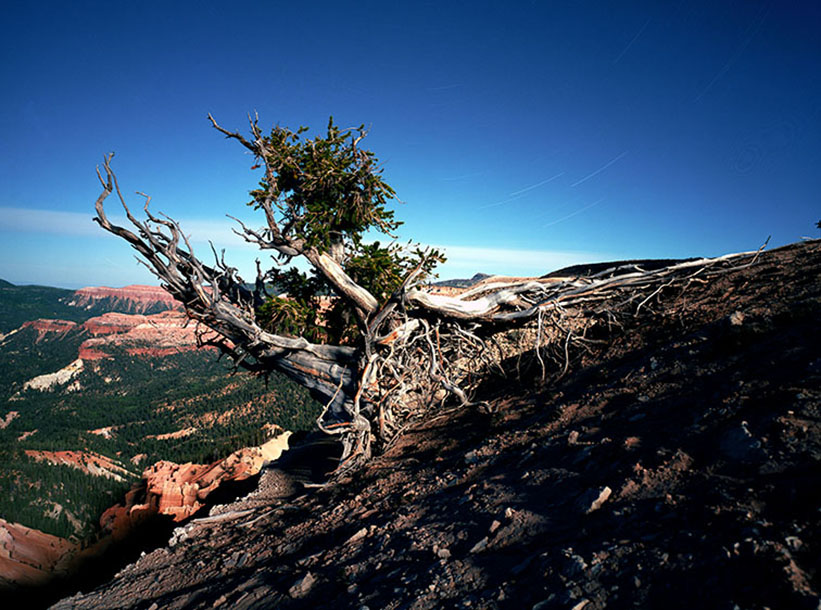
A bristlecone pine in the Cedar Bluffs badlands. Living above the treeline at 10,000 feet, there are no organisms that can hurt the tree. This pine coud easily be over 2,000 years old, This is a region known for the ancient lost people that left only their ruins and rock art that match the age of the bristlecone tree.
No trees for birds? The burrow owl answers, and I saw that. Twice I crossed paths with mountain lions.
There were only two other encounters with living things during these moon treks, and only one encounter that was truly out in the badlands. While hiking through the Bisti Badlands at 4:00 am, I passed a set of low erosional features, when a woman, hidden within a formation, that I startled, suddenly jumped up and out of the formation she had been enveloped in, and screamed. She told me she was “vision-questing” exchanged contact info, and I simply moved on into the Bisti on my customary very active pictures quest, leaving her to privately groove. We spoke a month later, there was nothing there. Each of us were on different missions, mine was pictures, the artifact of a struggle, hers was meditative.
The other time I ran into someone at night was at Zion, where I took an easy hike out to an overlook over the valley on the fourth night of a full moon quest. She was with her friend, was blind and was hiking out to the same view. One that she remembered before losing her sight.
Like the disappearance of one’s home, another lesson, about returning to something even if you can’t see it anymore. The inverted version would be a person with sight, returning to see his home gone.
PSYCHOLOGY OF ISOLATION
My BL questing is a constant physical probing of the landscape whose target is the unusual formation amongst the most unusual of landscapes. It’s the hunting and gathering of good pictures, and is the very antipode to meditation, even mediation – enacting a strenuous examination of this land. It gets me in touch with thinking in ways not normally accessed without exhaustion, and only one singular distraction of geologic formations.
Pictures is farming, probing and a hunt that takes and expends energy, in this case until nothing is left, and then continuing to finish the job. Not looking for dreams, connections, vision or guidance, but simply geography and geology, where the demands of that quest, clarifies mental activity and boosts it into invention, and certainly not the direction our world has taken – that of reinvention.
The object-quest keeps it physical while the exhaustion, labored breathing and constant movement ensures access to thoughts and ideas normally kept sealed, because your brain is enriched by fasting, extreme exercise, blood flow, tapping fats and activating neurotransmitters.
It’s a pictures quest, the visions are real and are the things that suffer erosion quickly and visually.
40 days alone in a desert? Forty days simply meant a long time, back then, but i dare anyone to try it for four days.
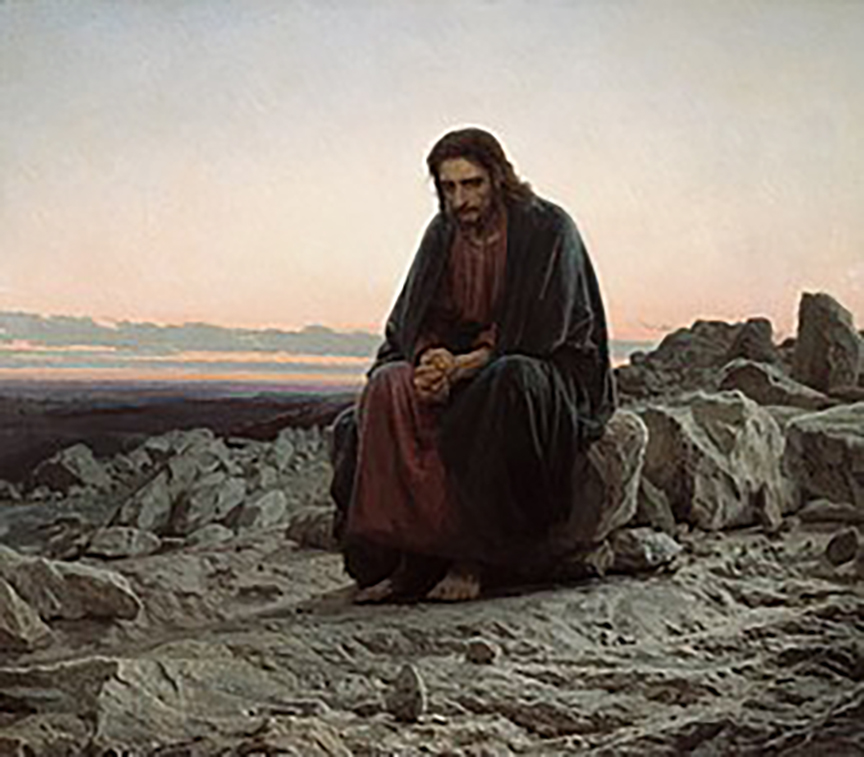
Nevertheless, the Bible says Jesus spent 40 days and nights in the desert and had three visits from Satan, Moses fasted twice for forty days each, and science tells us that fasting is one of only three activities that will aid in the growth of brain cells. Plains Indians might vision quest for 3 to 4 days and nights, or just one, in addition to a number of other ceremonies, where taking and using pain, and exhaustion, as in the cutting off of flesh or the sun dance, and skewering the flesh while staring at the sun.
But i would also cite the fictional, sarcastic Zarathustra and anyone who went under, over or into the landscape to come back with its rewards. Other, lightless paths to self-discovery and knowledge originate in the isolation of Plato’s cave or prison or disease where deprivation is not a limited quest. Upon release these rare birds often seemed doomed, and, whether religious or existential in their conversion, it seems a formation reaction, and many pass, while others remain controversial: X, King, Abbot. Some survive and keep it together, Mandela or Cervantes. And there is the man who penned Mein Kampf and has no redeeming value, but as a warning. Even he was more in touch with his “will” due to isolation.
Fasting, exhaustion and pain, like the Sundance, is active meditation entering heightened consciousness by discomfort.
I produce an artifact that is a recorded vision, and ten hours after leaving New York, I am deep into a desert wilderness with no trails, and in four days I have to come up with, hopefully, seven shots that make it all worthwhile.
A pictures quest has a literal objective, the collection of objects in the form of a vision or book. The objective of this vision quest is the collection of objects representing the American Badlands, and its byproduct for me is a dive into muted subjectivity and introspection and tapping into the areas of the mind, creating guidance, and even prophecy, or encountering Fate itself.
Then an object can will me, and, in this case, it’s the landscape. To get to that level it takes legs, stamina and motivation, or will, channeling the life force in the wilderness to act and not meditate. The camera “meditates” for ninety minutes on its object with absolutely no distortion and only clarity. I’m out hunting and gathering latent images, i won’t see for weeks, and never printed until years later, and only brought out on this site in 2020. It must be the experience.
As a machine the camera is capable of both objective and subjective renderings, but all this is operator-dependent producing a situation of cold capture. By quieting the will and desire, opinions and beliefs, and using everything, for concentration on the object, in a constantly moving and revealing light, that is not meditation, but pure movement, and letting the landscape will me and then i will shoot.
The notable emptiness of the bad lands, similar to life, if accepted in its full measure, could result in paths as dissimilar as deep meditation or strenuous work.
Meditation quiets the will, and so does objectivity, and, in the case of the pictures quest, the motivational qualities of the will are used for one thing and one thing only – find and get the shot, in an active, not meditative or passive, pursuit.
There are active meditations for visions and dreams, where pain and stamina pay a physical toll to enter a very heightened state of mind.
The quest is authentic being, it’s the measure of who you are, and in contact with the world of things, not sitting still, nor contemplation. In continental philosophical terms that would be Schopenhauer vs. Nietzsche, or the difference between an aesthete reaction and worldly action.
Speaking of which, Nietzsche, in Ecce Homo wrote that the idea of Zarathustra occurred to him by a “pyramidal block of stone” on the edge of Lake Silvaplana. Thinking, not meditating, while moving outside amongst things is a mentally inventive atmosphere capable of permitting higher knowledge, and, after some sleep, an enhanced well-being, and stands completely opposed to reinvention, remakes and flipping for fun, profit and art.
The pleasure of the landscape painting is the absence of people, no stories, a blank page, where one’e eye and mind aren’t so fenced in. Capturing a landscape is the flip of the viewing “experience.” while maintaining the open range and freedom thing. Do i will the land and its objects or do those things will me? It’s the latter, in my endeavors, and i like it. Then badlands can say a lot more things, one is, always act, never react, and by acting, i, too, can bring something back. The vision is not a dream, but a bunch of landscape pictures strung together in a book. It’s objective that way, and if i get bestowed with fate itself along the way, while working, what a pay-off, earned by virtue of the pictures quest, and forever respecting it.
On a purely physical level, exhaustion through hiking, climbing, falling, clinging, and slipping in the elements, with all that oxygen and blood circulating, has the biggest effects on the senses, and, with the silence, and, considering dry rocks and dirt don’t particularly smell, vision and touch (pain) is heightened drastically, especially visual perception, and physically, with so such a rod-reliant optical connection activated, motivated by survival, from roaming in the dark without a map, a trail, specific plan or supplies.
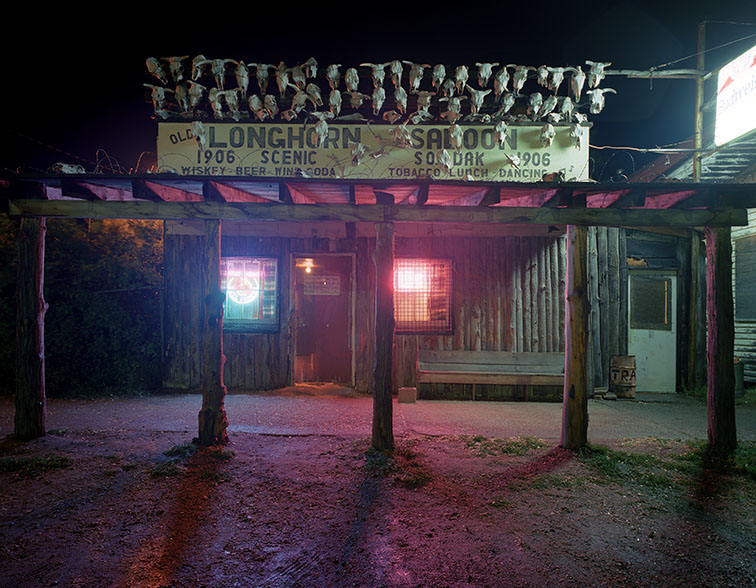
Once, while shooting the South Unit on a failed moonlight run, when a cut-off low poured out rain day and night for a week, i drove out on a dirt road through the badlands and farms, to the Longhorn Bar thirty miles south to Scenic which is a place that sits outside of, and in between, the two sections of the Big Badlands Park – North and South – the Lakota Reservation – and can sell booze since it’s in South Dakota, not federal and tribal lands.

The seats at the bar are tractors seats welded to oil drums, there’s sawdust on the floor and bullet holes in the ceiling, in a night where things could have gone anywhere. There i was given the name, “Maco Sica Hishola” when a bunch of Lakota i was partying with heard of my badlands exploits. Like cities, and the badlands, the place is plain real, and a guy from New York partying with young Lakota could go anywhere.
On my way back to Wall that night, a thirty mile run on dirt roads through the badlands, in a pouring rain, in complete desolation, a sheriff stopped e about half way back, asked if i seen any one else on the road this night, and that was it. Or was he checking my ass out?
A PICTURES MISSION
I wasn’t doing what an ancient or Indian culture does in the deserts, when they venture into a desolate place, for ceremonial purposes, or practices meant to spur subjective dreams, visions, as well as, guide personal and tribal destiny. I ventured alone and at night without food or water into all the American Badlands, over a period of seven years, with 30 pounds of photographic equipment to gather shots from a landscape that is a universal pull (desolation and beauty) for any animal that walks on two legs, and will, of course, leave, a better and more defined person, as a byproduct of the pictures quest. Depravation, meditation by exhaustion and being alone in a vast landscape is a universal practice to access more brain power, on both an anatomical and intellectual level.
The official version is that fasting began in Greece in 500 bce, but was a normal part of everyday life way back when humans lived close to the bone with no real technology, and had no choice but to fast until the next available meal. Regardless, fasting is healthy. This pictures quest, is, of course, about capture, while exhaustion, and a singular presence in a wasteland produces the same mental and physical benefits, particularly clarity, mind expansion, definition and a look at your destiny. It’s ultimately and simply a search for lands, erosion, and formations that become objectively etched in a negative, mostly PHR 25, from the golden age of color film photography.
And it has other benefits.
When a human puts themselves in a place of discomfort with no resources in a vast strange landscape, as the lone individual, eliminating all distractions, with any conversations only to the self, things not normally seen or in touch with come into view. Night, storms, lightning, cold and snow, help bring out normally unfound characteristics and discovery of what you are made of, and is forced. Unlike the unchallenging meditative qualities of a peaceful landscape visit, akin to being tourist, my scene is silent and desolate as well, but I’m climbing, hiking and crawling all over it. A geologist hunting for a particular stone that is of value, but never actually taking a thing, but an image. It sounds very respectful and reciprocating. It’s four days and nights and, pictures mission or not, it’s always a rite of passage, never a goofy apprenticeship.
These are places with no seemingly stabile traits or features and a place where each landmark completely changes according to the angle of view. The landscape of perfect chaos is metaphorically built to get lost in. This was the side benefit from the pursuit of images in isolation out in the actual world of existence – stripped down to a raw land of no living things, where, whether you want it or not, self-knowledge is successfully mined. Thing-driven earned ideas and areas of the mind that cannot be activated unless isolation, depravation and exhaustion, challenged in a stark unloving landscape. That will, forces such a heightened star of awareness, it ain’t funny.
Whether mission or quest, the goal is pictures. I already mentioned the professional reasons behind a book, and i wanted to do something not seen at the time, that i wanted to see, but without any real interest in actually seeing it, since i’m so busy creating it. I truly didn’t actually see it myself in any substantial way until 2003 when i began to make prints. By 2006 moonlit landscapes, even seascapes caught on significantly with the ease of digital capture. With digital, i can, for the first time, see my shots immediately and on location. I’m pretty much aware, having shot this light for fifteen years prior to this book, called This Bad Land. What’s been done with moon and film, has become popularized long after i began doing it, because of digital photography and the gossiping internet of trolls.
When i shot Zion, 3.5 hours from Vegas, i still had to shield the lens for every jet that passed over the landscape i was aiming at, otherwise it would have appeared as a stark of light across the frame. There is no concern, with this, technically speaking in digital, and many ways that make its use in the field a breeze. But the difficulties of slow speed film allowed for ultra-long exposures, and with digital I could do the same thing in 10 or 15 minutes.
A pictures mission fundamentally differs with the so-called traditional vision quest. It’s a mission whose object is pictures, not visions, soul-searching or self-discovery. The goal is external to the self and the objective is the discovery of a physical object to capture it on another physical object – the negative. The visions are real, and in their pursuit i can get similar benefits to the vision quest with the soul bared, not from meditation, dreaming and looking for visions, but constant, sometimes extreme, physical exertion that heightens the feeling of being alive, while in the world’s most lifeless spots, while searching for physical vistas and geological objects. With so much layering removed, your individual fate defined, sharpened and clearer than ever, comes from working the landscape. The only value for deprivation and exhaustion, is to get closer to usually hidden areas of awareness and perception. Writing can also accomplish this and but always has somewhat a meditative stance, and that’s why, during This Bad Land, I wrote, literally on the run. But it’s the physicality of the pictures pursuit that opens things up mentally and also makes you feel so well afterwards. Nutrients burning and eventually draining from your system, blood surging and thirst building to the relief – job done, goals met, which is a batch of negatives etched with the aid of moonlight.
A pictures quest, of course, is endowed with meaning that becomes visible within a large emptying out of nature’s already prebuilt emptiness, often with long bouts of silence on those shoots devoid of rain, thunder, snow, wind, heat, ice and energy production bordering the parks. The silent nights in raw open land, on top of tables and within the mazes of formations, lit fairly by a full moon, was an exercise in strengthening the senses.
I’m hunting objects, not looking for visions, or even pictures for that matter, and i will capture the objects that are hunted on a pictures mission, as soon as seen, then set up and move on. While in it, i’m only looking for something of interest that is always gonna be a solid, a thing. Risk and reward, sort of on the level of hunting for food, but the nourishment enters the eyes, followed quickly by the mind and nervous system. Rest, food and water will wait until dawn. You probe and when you hit what is looking for you, it’s a very clean, sensory high. There’s no time for grooving, and you happily get busy setting up the shot, hit and lock the cable release and move to the next location, with cameras strung out, like this, all night long.
Probably the most visited park by tourists, was Bryce Canyon, even in late autumn, yet by shooting at night, i never saw a soul, not even on the parkway as i drove to trailheads to go down into the hoodoo vistas seen from the rim. There were only one encounter with people during these moon treks, which was in the Bisti Badlands of New Mexico.
If Jesus spends forty days in the desert today, he would see a lot of people, and might be ticketed for overstaying his permit or agreement, because all land is managed now.
In literature we learn that Jesus spent 40 days and nights in the desert and had frequent visits from Satan. Moses fasted twice for forty days. Science tells us that fasting is one of only three activities that will aid in the growth of brain cells. Plains Indians might vision quest for 3 to 4 days and nights, in addition to a number of other ceremonies that utilize pain, and exhaustion as in the cutting off of flesh or the sun dance and skewering the flesh while staring at the sun. Try four days, alone. That’s more difficult without a camera, which forces you all over the place, and provides the solid goal.
I would cite the fictional alter-ego of a renowned existentialist, Zarathustra, and anyone who has went under, over or into the landscape to come back with its rewards. Other, darker paths to self-discovery and knowledge originate in the isolation of prison where deprivation is more of an always, and not a limited quest. Upon release these rare birds often seemed doomed, from Malcom X, Jean Genet Jack Abbott, even the worst tyrant of modern times wrote his manifesto in prison. But this is forced isolation that is redeemed through representation and thought. The badlands is simply the best possible place for voluntary and chosen isolation, not at all, in a room, but an immense outdoor real garden of geologic formations. I went there for shots, isolation, when you’re alone, is simply part of it.
I would have taken shots of people, but there weren’t any and to get them to sit still in the moonlight for ninety minutes… In reality there was no time for people. I got one week to get it done and people, sometimes take time, but you don’t need a landscape’s permission or gain its trust over time. Landscapes, by nature, are the fields for actions, free will and discovery, and their openness is an invitation to freedom. I’m thoroughly bugged by the use of the word “narratives” today since it’s a marker, today, for a flow of bull shit that is about to occur. I keep my life within life itself – episodic, and not a story, already. When you shoot landscapes, not people, there are no compromises to gain entry. There is no “narrative” here while, even in civilization, that word cannot be trusted, and, in the civilized world, is purely subjective.
Aside from the obvious vision questing, American badlands have had a purpose, too – oil, gas, mineral and fossil collection, or for outlaws seeking temporary or permanent reclusion. The most famous of these is the Wild Bunch who were highly successful at disappearing into the canyons off the Outlaw trail, where prior knowledge of the land is a big advantage, while folks like Butch Cassidy were raised along the Trail, in an area of Utah known for being an outlaw haven – religious and criminal. Cassidy, et al, were experts in the badlands regions and targeting springs and secret corrals and homesteads far up into the washes, coulee and canyons. The Outlaw Trail, running 2000 miles north and south coursed through the badder lands of Wyoming, Utah and Montana.
My experience of the badlands’ emptiness is that of a cave turned inside out, and its advantage is that of leaving a person of clearer mind and with stronger legs. Depravation, exhaustion being alone and/or meditation in a vast landscape is a universal practice throughout time that knows bare survival, pain and stamina might empty out body and mind, and write on some clean slate.
In Makosica Park, Montana i was shooting a formation in a coulee around 2:00 am, and over the rise above me i could see and hear an approaching thunderstorm. I was already about twenty minutes into a much longer exposure, there was no cover anywhere, and i decided to just stand my ground, next to the camera and protect it from rain. There was no shelter. The storm came slowly and directly and over me with extremely loud claps of thunder and many large bolts of lightning, that crept towards me like rolling artillery fire. It finally rolled over me, and was loud, visually alarming and another way to force my system into new awareness whether pleasant or threatening. So in a situation like this, you get the relief thing, not getting hurt or kilt, but also a picture, in my case a negative. What a boost, and a booster shot to your life.
The entire book was made with no proofs or prints, and, from my vast experience with moonlight, i wasn’t wasting my time, and i was fairly confident, but, still, it was never proofed until well after the book was completed.
A shot was rewarded with a negative, that was put into the archive and never printed, along with a host of other books, as though, I was a picture-shaman predicting that when I would finally getting around to printing and seeing what i had done, it all would be good.
SYNTHESIS
A way of being or philosophy where the senses, landscape and mind combine through physical labor, and a goal, in this case, pictures. Thinking in a vast, silent, empty outdoors, while expending the energy to get there, boosts the brain activity to a cleaner and directly accessible consciousness. An alertness that has no match, except, perhaps, the surviving of sure death. The resulting appreciation for pure life, and increased perception by all the senses at once, is phenomenal. Mind, body, soul, compressed, flattened to one.
A two-legged puts themselves in a place of discomfort with no resources in a vast strange lifeless landscape, as a lone living individual, eliminating all distractions, with the only discourse internal, as the mind and body, focus, and things not normally seen or in touch with, can surface. The often exhilarating exhaustion allows touching an area we just carry around with us and rarely tap. Along with it always being night, there are storms, lightning, thunder, cold and snow, that expose, evaluate and test the characteristics one is supposed to be known for, or made of. It’s an evaluation forced true, by physical struggle and reactions to extreme atmospheric conditions, silence and stone. And yet the more unchallenging meditative stance is always there to dip into, like when, for some reason, all the tripods and cameras have been planted close to one another, and there is some minutes to kill instead of using it to head out and scout the next location. It’s a resting period, with thankful appreciative glimpses to the land, and they were few. I was there to work the landscape silently and taking nothing that wasn’t mine to begin with.
The situations that occur from bad timing and place, can turn a simple good, hard productive trip into an existential dilemma, getting stuck in mud, that when hardened will cement the vehicle into place, sixty miles from the nearest wrecker, thunderstorms with unrelenting lightning, that, with no cover, you simply stand and let it pass. But something that for an existentialist, or, at least, a man of action, is murder, the ultimate waste of time, being completely rained out by a cut-off low directly overhead for days, in a motel room that sits in the middle of nowhere.
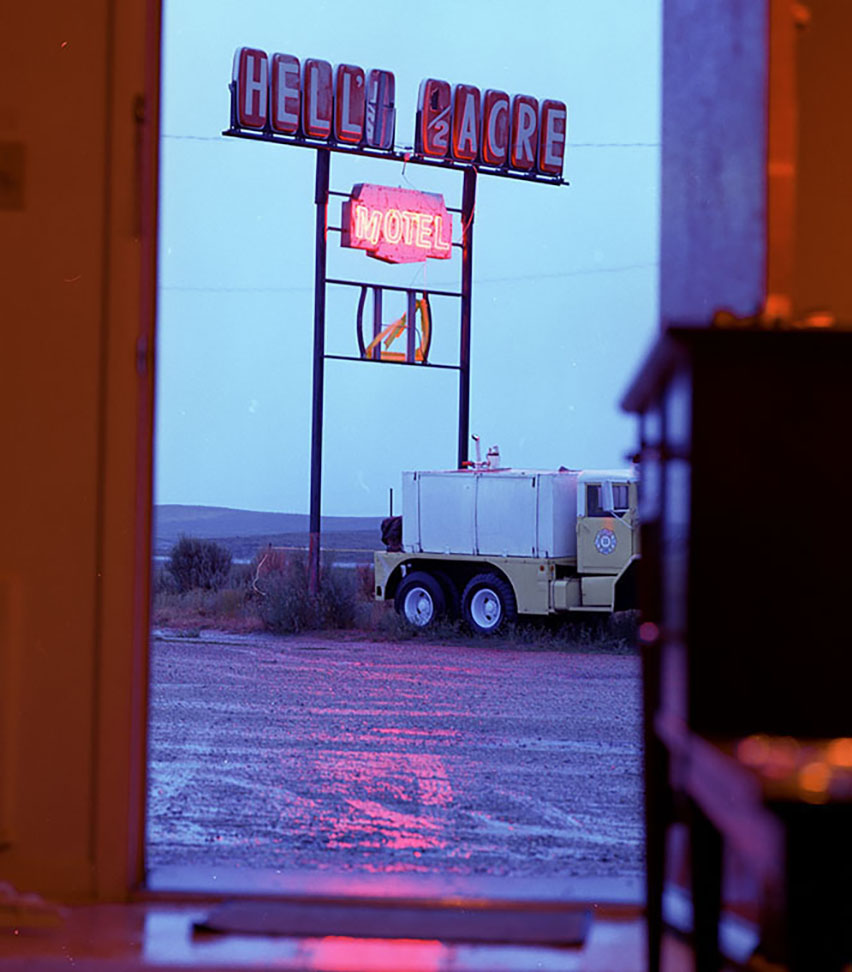
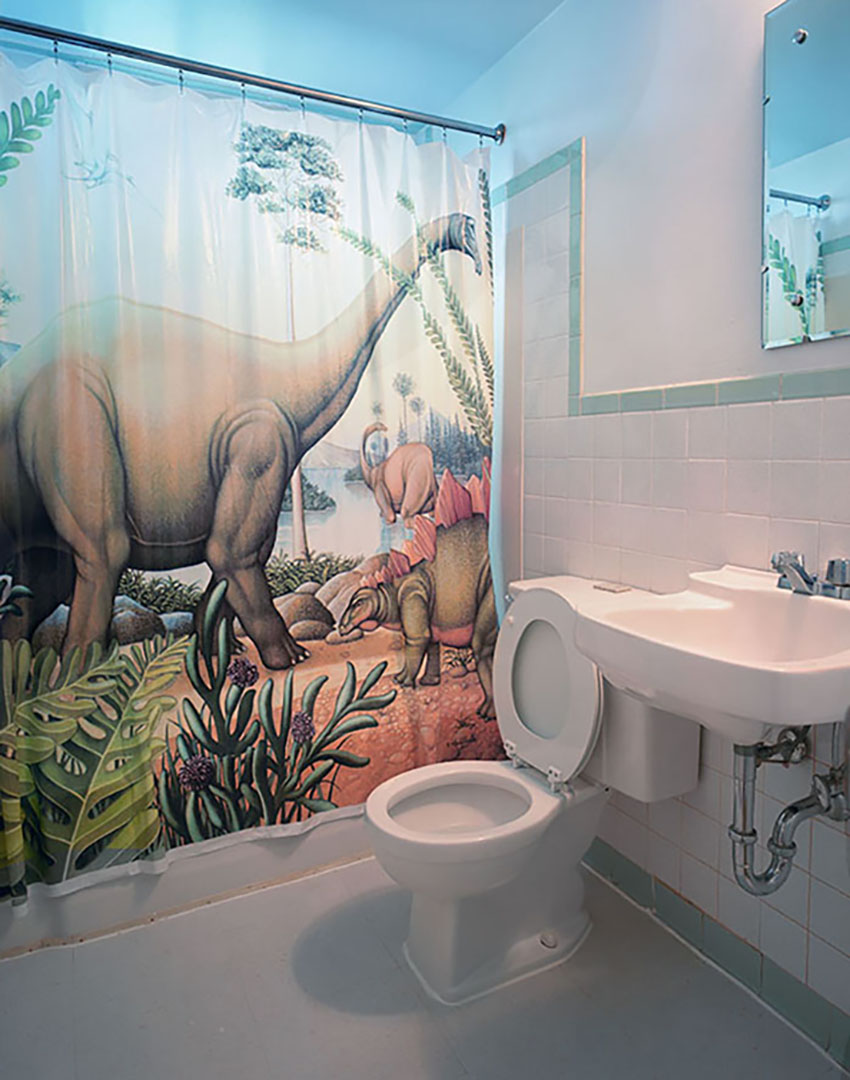
Cheap western motels, that i spent a lot of time in, particularly if a shoot was rained out. Hell’s Half Acre, the county park in the middle of nowhere, in Wyoming, actually had an old motel, bar and diner, sitting right at the edge of the badlands, featured in the satirical high-budget film, Starship Troppers. Convenience to a major badlands is a blessing, but to have a small diner and motel room practically in the badlands is heaven.
The lower shot is the bathroom of the Dinosaur Inn, which is gone today, as is, the Hell’s Half Acre Motel,. The bathroom was the nicest room in this motel. The room i had was a combination of used furniture from different eras, shag carpets, as well as, a bookcase filled with a large collection books, and, unlike the bathroom dirty as hell, as if this was a cheap motel in the middle of Wyoming.
But considering a clear night sky is the plan, that was how 70% of the trips went, and this is without computers and the internet, and using my neighbor’s cable to catch the weather channel and see where the jet stream was located during the week of that month’s full moon.
For four days and nights, fasting, surviving, or perhaps thriving. I know, i did. By 2006 I could no longer go out and use every full moon for light, like I had for the previous thirty years, although I still do as much as i can. Nowhere did the moonlit landscape work better than in the badlands, at night in the chaos of hoodoos, pinnacles, tables, washes, coulees and ridges.
There are far less recognizable, and dependable traits in BL formations than any others, because it’s a place where each landmark completely changes according to the angle of view, lighting and atmosphere. Monuments like the The temples of the Sun and Moon in Cathedral Valley were so immense they couldn’t be missed, but even they had different looks as you circled around each one one on the massive valley floors. When something is named, Cedar Butte, it’s always, which one? The whole chaotic arrangement due to its composition of packed dirt makes it the fastest changing landscape, its bare surfaces exposed to all sorts of extreme weather. The landscape of perfect chaos is metaphorically built to get lost in i suppose, but with the pictures duty, there was always that goal. Twice, i couldn’t find my camera placement site, even with a flashlight, once taking 30 minutes of searching.
The side benefit from the pursuit of images in isolation is getting to get close to the idea of the pictures quest. Everything is stripped down to a raw land of no living things, where, whether you want it or not, self-knowledge will be mined and areas of the mind that cannot be activated under normal conditions, but by isolation, depravation and exhaustion in a stark and dead landscape with no resources, out and in the actual world of existence and things. That becomes the theme, and, particularly four nights a month, over a period of many years, becomes ingrained and part of your existence.The sun and the moon, the 28 day cycle of life as influenced by the moon, who thinks of these things? In the Americas it was actually quite the thing for thousands of years. Knowledge related to the skies, sun, moon and planets was the most critical and important information in many American cultures.
Existence sticks out here. No life around here, so its value is one of the things clearly seen.
Rock art, sometimes bristlecone pine, fossils, fossil fuels and newer energy like fracking, solar and wind, is always nearby in these treeless lands. In the De Na Zin, one of the most remote of the badlands regions, i would hear mechanical noises far, far off, all night, or in Fantasy Canyon, another extremely isolated region, with roads for drilling and its truck traffic, a drilling site could be made out miles away. But by far the greatest treat, while in Wyoming and Utah there was nearby rock art that before and after the three big moon nights i could visit and could shoot its moonlit surfaces when it wasn’t a pictures mission and when there was some time for this. The immediate badlands areas, with their changing geologies, couldn’t preserve any rock art, but heading out into the solid rock formations sometimes close to the badlands’ parks, there was often rock art especially surrounding the Goblin Valley badlands or Fantasy Canyon.\

After shooting Hell’s Half Acre in Wyoming, i had enough moon left to venture into the Salt Creek Oil Field, the first and largest oil field in the state and is still in operation.
A seriously developed and still operational oil patch, seen here before fracking in 1997, with abundance of pumpjacks and loads of hydrogen sulfide in the air.
Badlands, a great location to find fossils of dinosaurs, and fossil fuels.
40 days alone in a desert? I dare anyone to try it for four days. I’ve met so may people, the ones with the personality disorders like hyper-narcissism, that need nothing more than what they absolutely could never do – be alone.
Many people today, if they could take it, need to get alone. Narcissism and ego are the prevailing quandaries, and these are the folks who need to isolate the most, but due to their condition – the need for other people to dominate and act out on, but they never will. The hit to a two-way act like communication, the basis of civilization, is deadening. The one thing the monster ego of today couldn’t take is being alone, especially in a vast landscape where the damaging illusion of the narcissist would be cut off socially, the mirrors gone, perhaps even finally realizing that
mostly everyone thinks, you’re an asshole, and finally learning that no one gives a shit what you think.
In a vision quest ideas generated are clear, and if you take a camera they are proven, and if you survive, perhaps with that sharp shot, it’s transformative in a very positive way for the shooter, as isolation, physical exertion, and survival play out in the field, with photography as the excuse, and reward, even though not a thing was taken, but pictures, and then never shown.
Night for day and long time exposures is an added difference while preserving the drama or significance of an event in a precise organization of form. I began the lunar light thing forty years ago, and, have, since, become connected and knowledgeable about it.
“To me, photography is the simultaneous recognition, in a fraction of a second, of the significance of an event as well as of a precise organization of forms which give that event its proper expression”
– Henri Cartier-Bresson
If one goes into a wilderness with no food or water or weapons for days and nights, a combination of exhaustion, hunger, thirst and new ways of surviving, can easily get you in touch with physical and mental sates untapped by normal life. Combined with charged emotions of wonder and fear – being stalked by a mountain lion the whole time or, unsheltered, with no place to hide, from brutal unrelenting thunderstorms and lightning, that, at night, become quite monstrous and dangerous, and you simply stand your ground and think, because you never stop thinking, and thinking like this is like no other.
I perform a pictures quest, but the term, vision quest is probably more of an English interpretation, and an umbrella term, but as a spiritual action and an act of self-discovery, it’s been around a very long time, well before Jesus’ forty days and nights which is a really long time. 40 days alone in a desert? I dare anyone to try it for four days. Fasting, and willful depravation, has scientific proof to its effects as one of the few ways that BDNF is produced, which is the physical and biological end of mind expansion techniques.
INDIANS
American Indians, using widespread rock art or the Lakota history belts as an example, were visually oriented, almost exclusively when it came to their records and culture, while so much other communication was done by signaling with sign language, smoke or noise, and opposite for the European and Asian culture of documentation, stories and records-keeping originally chiseled in stone and later with pen and ink, then the printing press and onward technically. The native Americans, largely isolated for so long on two continents, were remarkable in their deeply visual culture, with the exceptions of tribes like the Mayan and others who wrote in stone, but still used hieroglyphs. Papyrus and ink began to change the world outside of the Americas, around 3000 BCE, spread and became one of the great advancements, through to parchment and then paper. All this had been going on in Northern Africa, Asia and Europe for thousands of years, while American Indians remained picture-oriented and vocal in their communications.
This Bad Land is a simple pictures quest in fifteen American badlands during the week of the full moon over a period of seven years that i wish were longer, much longer. It’s about seeing at night in, what seems, the classic landscape for a search.
I’m not sure if vision quest is an Indian term, but they define it, and within that, the Lakota, personified it. If you look at the longer broader view the Lakota had a home base around the badlands for centuries, but there have been many others living here before they took it over with the help of the Europeans’ horses and guns. The Indian version of what we call the vision quest was, for most tribes, a coming of age ritual for young men, However meditation, dreaming and visions were taken very seriously by tribal elders and leaders. The first meaningful visions of children, were important guides and prophecies. Sitting Bull personifies this more than anyone, perhaps because he welcomed, somewhat, his own documentation, then came to represent what he spoke of, because, “It is enough.”
Most famously in the Ghost Dances of 1890, at Stronghold Table and further southeast at Wounded Knee events occurred that would forever make the spirituality of the Lakota, linked to militancy, or, at least, defensive according to the historic abuses of them in their own land, and with their spatial connection to the landscape and the ancients. The shirts would be bullet proof, and the dance would help get in touch with the deceased ones, and, lord knows, there were plenty. The obvious fact is that people pushed to extinction would gravitate to a stronghold of visions and dreams, dreams and visions helped by exhaustion, stamina and pain in the dances to the ancestors and the sun.
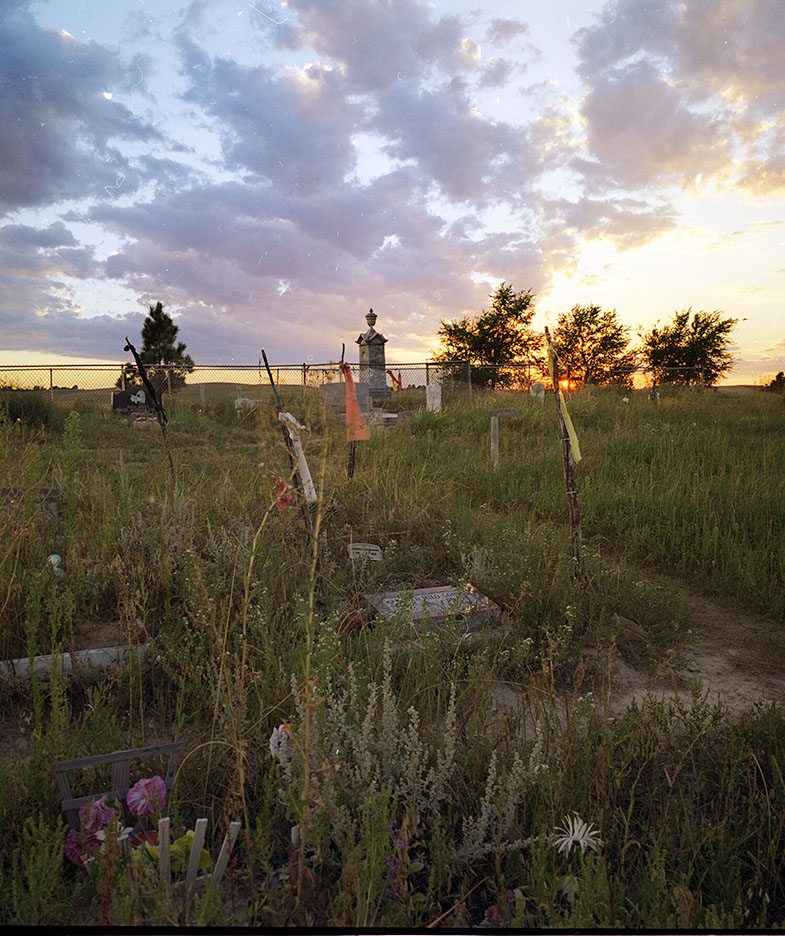
The cemetery at Wounded Knee is an active burial ground, even today. Its graves are mixtures of Indian and non-Indian practices. Individuals were sometimes placed in a burial ground that was designated to place tribal members after thay died, or even brought privately to a place that only family knew. Whether it be a wooden scaffold, sometimes lit on fire, or in a cave or under rocks, the body was left for the animals and insects to act out the circle of life and death.
Sitting Bull personifies this more than anyone, as incorporating the his penchant for visions as one of his many skills as a combination of chief, shaman, medicine man and warrior.
Native American visionaries made notable dreams beyond self-discovery, while still firmly linked to destiny, with visions that answered to tribal/national questions, conflicts and what to do. Sitting Bull, because he was the Last Indian in the time of their extinction and during the time of written and photographic documentation that he, unlike Crazy Horse, fully participated in, is our best example, along with many others, like Geronimo, that were recorded in some way, by records, news, history and stories. The last ones and leaders of their people, as stated, sought visions for communal guidance and not that of the individual. Written and photographic documentation of Indians were a feature beginning the 1800s, probably culminating in the work of Edwin Curtis, so we can simply look now at our recorded past to unearth the facts of the Native ceremonies. I would direct people to the archive and research of Sitting Bull’s sun-dance and visions on the eve of the Battle of the Little Big Horn, and his speech and dance afterwards which was also a ritual for uniting the Lakota and Cheyenne against the soldiers who they now knew were close, and, with Sitting Bull’s vision, they knew they would win.
American Indians, using widespread rock art or the Lakota history belts as an example, were visually oriented, almost exclusively when it came to their records and culture, while so much other communication was done by signaling with sign language, smoke or noise, and opposite for the European and Asian culture of documentation, stories and records-keeping originally chiseled in stone and later with pen and ink, then the printing press and onward technically.erThe native Americans, largely isolated for so long on two continents, were remarkable in their deeply visual culture, with the exception of tribes like the Mayan and others who wrote in stone, but still using hieroglyph methods.
Papyrus and ink began to change the world outside of the Americas, around 3000 BCE, spread and became one of the great advancements, through to parchment and then paper. All this had been going on in Northern Africa, Asia and Europe for thousands of years, while American Indians remained picture-oriented and vocal in their communications.
American Indians have become associated with the classic American “vision quest” especially the Lakota. Yet all tribes had ceremonies and practices that were similar including Sundances, all over the American west.
Lakota tribes became very symbolic of the overall defeat of Indians. The documented and dramatic changes and tragedies, not just the skill and bravery of the warriors, was recorded, including the most memorable American defeat in history, as well as, the most tragic Indian event in a sea of tragedies endured by Indians. From the Little Big Horn to Wounded Knee, it’s entirely documented in modern terms and ways, so perhaps all that might have something to do with the Lakota’s affinity and identification with the idea of self-discovery and prophecy in the wilderness.
Add to this, the most representative badlands in size and scale are in South Dakota, and are next to and part of the Lakota Reservations, where so much spiritual activity took place over the years, in an unusual looking land that was the ideal landscape to isolate, and dream.

The Lakota are so identified with the vision quest or sun dancing because, their accounts are some of the most dramatic, but also because of new technology that allowed widespread disseminating and recording of information by pen and camera, newspapers and books, while not written in stone, and subject to prevailing notions, still can deliver the facts of events.
And once you read the clearly documented experiences of the spiritual leaders from the 1800s during the time of their demise in the Badlands with the Ghost Dance, it’s so powerful, that the identity of this universal mode of self-discovery, is definitely influenced by the Lakota. On their land itself, culminating in the Ghost Dances that led to Wounded Knee, the badlands offered isolation, protection by that isolation, starkness and beauty, and on a very large scale.
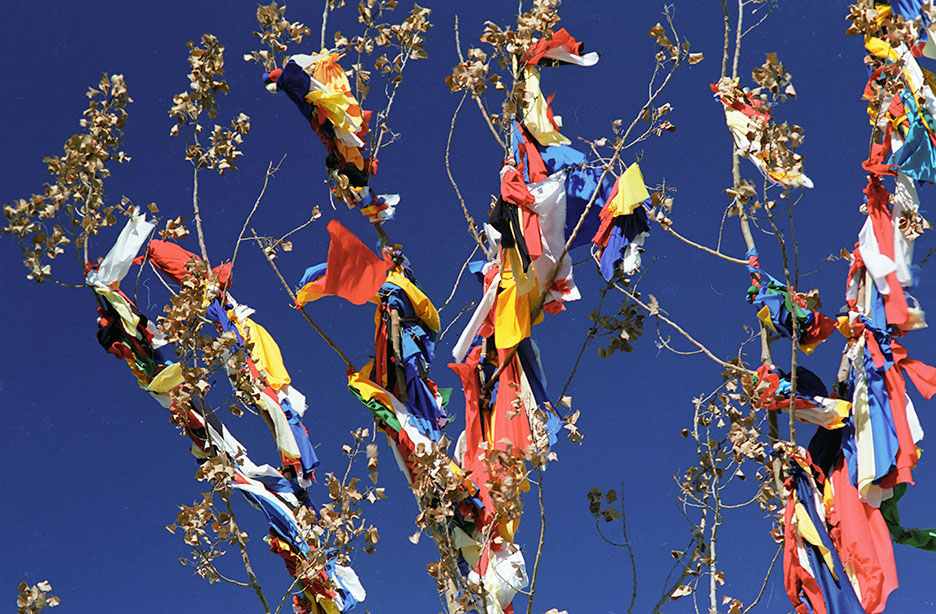
In the southern unit of the Big Badlands Park that is also home to the Lakota, there are always many signs of the interaction of the landscape and people. You could go up Sheep Mountain Table now you would find the colorful bows, and prayer offerings that mark this part of the land as significant. Between the famous Stronghold Table and Coffin Butte, a larger ceremonial landscapes can be seen – painted trees, limbs with ribbons hanging, for the sun dance.
I don’t know if vision quest is an Indian term or not, but they define it, and within the Tribes, the Lakota, probably personified it. The Lakota had had a home base around the badlands for a few centuries. With the horse, they moved out into the parries and western plains. But there have been many others living here before the Lakota took it over with the help of the Europeans’ horses and guns. Our version of the umbrella term, vision quest. was, for most Indian tribes, a different matter that should be respected, and not even copied, but let alone. It was a coming of age ritual for young men, However meditation, dreaming and visions were taken very seriously by tribal elders and leaders, and many people, and certain individuals that had a particular affinity to it, would grow to be shamans and spiritual leaders. It became not just the first meaningful visions of children, but important guides and prophecies for the entire tribe.
INDIAN 2
1993 Declaration of War Against Exploiters of Lakota Spirituality easily understood by their history, most famously in the Ghost Dances of 1890, particularly Stronghold Table and further southeast Wounded Knee, that are places forever linked to the spirituality of the Lakota and its militant commitment to its principals, and its sacrifices. The development of the west that made them such targets due their extraordinary resistance which was partially due to their spatial connection to the landscape and the others that came before, that made them fight hard and long. Sitting Bull was killed on December 19, 1890, and Wounded Knee occurred on December 29th.
When you’re in the Big Badlands in South Dakota it’s different from most badlands because of the human history where, even today, the artifacts of spiritual visits are all over the place in the South Unit which is Lakota land. Unfortunately, the human history of the region become more than tragic by the 1700s culminating in the most haunting event in the history of the United States – The Ghost Dancers, the death of Crazy Horse and Sitting Bull, and, Wounded Knee. People like Crazy Horse and Sitting Bull, both vision quested in their youth, with Sitting Bull making it part of his lifelong role as a medicine man, warrior, shaman and spiritual leader. Even predicting his own death when a bird told him about it. Prior to his quest for identity, Crazy Horse was know as Curly by his mother, but he didn’t earn Crazy Horse, his father’s name, through visions, but battles. Sitting Bull, had a vision days before the Little Big Horn that was like a movie of what would happen and also what not to do, but was done, after so many soldiers fell.
The shirts would be bullet proof, and the dance would help get in touch with the deceased ones. But don’t even draw back or question that, because Crazy Horse was said to be given a vision that no bullet of the enemy would ever harm him, and, when he was murdered, it was a bayonet that pierced his lower back, only allowing him to live for another twelve hours, and this happened at Fort Robinson.
In 1854, Crazy Horse rode off into the prairies for a vision quest, purposefully ignoring the required rituals. Fasting for two days, Crazy Horse had a vision of an unadorned horseman who directed him to present himself in the same way, with no more than one feather and never a war bonnet. He was also told to toss dust over his horse before entering battle and to place a stone behind his ear and directed to never take anything for himself.
Know one knows for certain the location of the remains of Crazy Horse, most say around Porcupine Butte, close by Wounded Knee, that is south of the South Unit of the Big Badlands. It’s easy, given the history of this land, to understand a badlands region of the country with such a haunted tragic recent past, and where tribes have wandered over for 11,000 years of proven history and, of course, far longer.
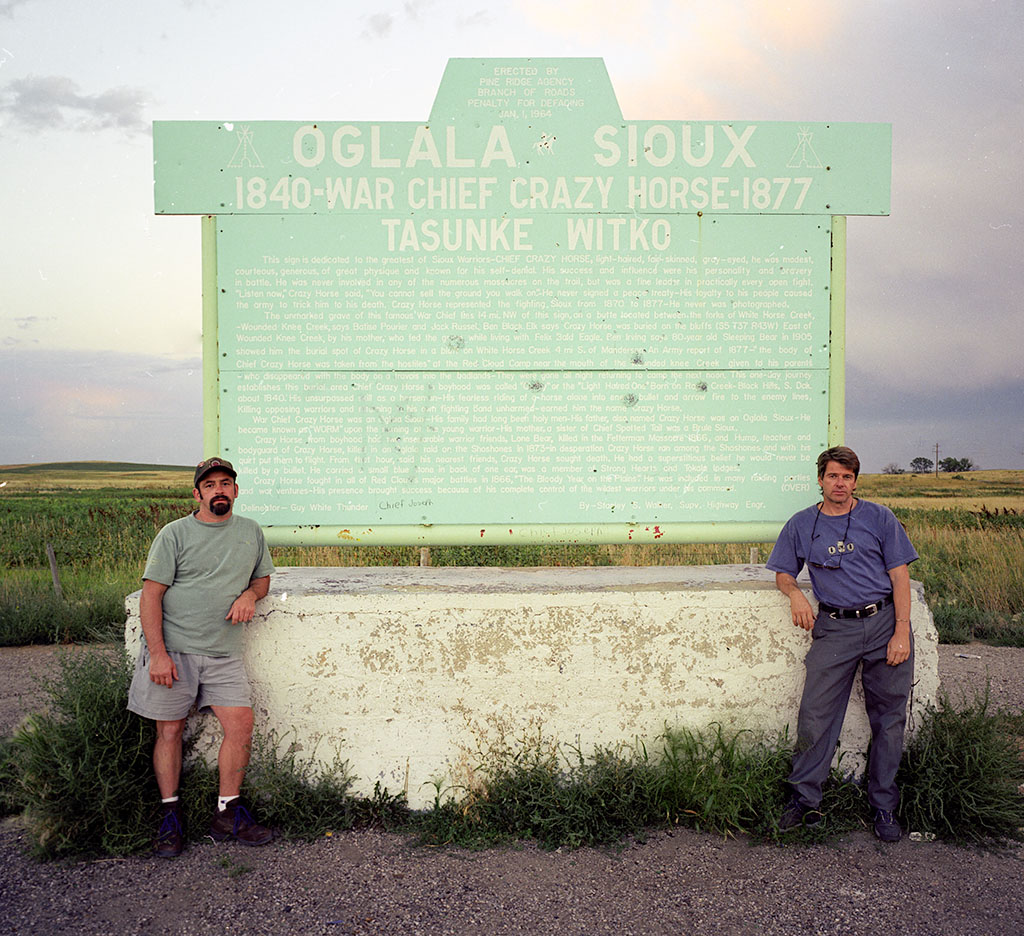
Fourteen miles from where Crazy Horse is supposed to be buried, an American civil engineer constructed this memorial marker. People do reclusive things for a reason, not just eccentricity. Listening to actions of Crazy Horse, and his family, his mother and father privately “buried their son because this was their way, the Indian path. Obviously professional historians, etc. were going to interview folks in an effort to locate the “burial” site, which by custom cannot be specifically found anyways.
The memorial sign just about gives you a written directions. I’m appreciative to the recognition of the man as a leader and a warrior, but in bewilderment for the penchant for, not to just examine the past, but a strong desire to even dig up graves, do scientific analysis on the remains and take any found artifacts for display.
Fortunately Crazy Horse’s burial site has not been found.
Native American visionaries made notable dreams beyond self-discovery, while still firmly linked to destiny, these visions answered to tribal/national questions, conflicts and what to do. Big Badlands, became, for a tragic reason, highly associated with the practice, cemented further by the association of two great Americans – Sitting Bull and Crazy Horse, and the fact that they were seen as the last holdouts, taking on a symbolism like that of Uncas and collection. This level and depth of human historic tragedy is not present in the other badlands regions that i shot, although the Apache leaders, much further south, were equals in this resistance and spirituality, and many more. I certainly understand the Lakota’s1993 Declaration of War Against Exploiters of Lakota Spirituality http://www.thepeoplespaths.net/articles/ladecwar.htm that addressed the copycat/flipping culture of many modern Americans that has evolved so well into the society of the remake and reinvention.
The dominant and largest badlands preserve in America in South Dakota has a “shared” control of the South Unit of that park, a huge and largely unvisited badlands. Even less visited is the Palmer Creek section of this unit, a roadless wilderness. Prior to Red Cloud’s treaty all of this and parts of Montana, Wyoming, Nebraska and North Dakota was entirely Lakota land, by virtue of being able to fight and hold it. Other badlands like Bisti and the De-Na-Zin bordered Navajo land, and, places in the San Rafael Swell in Utah were all ancient Indian lands, tribes who left thousands of years ago, leaving their rock art. But the Big Badlands of South Dakota, with so much blood spilled on it, along with ceremonies and gatherings, some on a very large scale, within it, has made this place synonymous with Natives, and their culture.
Yet, in the larger picture, all of the Americas, badlands or not, was inhabited only by Natives.

LAST
One thing every living thing shares, is not one of us asked to be here, in a decision made by our parents. My brother and mother arrived here before i was born here. Loving the land, not country, first, particularly its spiritual center of bad territories that occurs when everything is stripped off, top down, exposing what’s below our surface and what happens when exposed to wind, rain, snow, ad wind.
A rite of passage apprenticeship for youth guided by elders is nothing new and is not merely an Indian invention, nor is wandering in the wilderness for answers, inspiration, meditation and the discovery of objects wondrous enough for recording. Jesus, Moses, the Wild Bunch, spent significant time isolated in deserts.
In the larger picture this type of search for hidden answers and fate is universal. The Badlands had such a hold for me, even before arriving, by simply seeing pictures of them, i had to get there, and, on a stolen trip, when i had my first camera in the seventies, it’s the first place I went with that machine, for discovery and capture, in a land, turned inside out, and synonymous with the fossils.
The spots where ways of being, seeing and knowing are thought about, in pictures with no name, were left to lie in my archive for more than twenty years. As stated, Jesus, the greatest symbol of European culture and sometimes enlisted in the conquest of the new World, also wandered into the desert, and, there, met Satan. Although “forty” back then was slang for a long time, try just four days and nights and see what you will get in touch with.
Speaking of Satanic folks although incapable, it’s just what the despot-narcissists need, to be alone with themselves, and see things clearly, realizing unequivocally and with proof that they are definitive assholes.
Generally quiet, silent and still in the summer moons, the night thunderstorm, particularly in the northern badlands of Montana and Wyoming, could be amongst the loudest, anyone could hear, and it was the quality of that sound when it passes over you, particularly in “dry” storms, where the scale, heaviness and deepness of that thunder, combined with the landscape now completely lit in flashes, and you understand that, even with people born to this environment, the thunderstorm was more than simply powerful. Unsheltered, with no place to hide, and combined with lightning passing over, it’s a show with risk. But you never stop thinking, especially when your back is to a wall, and things become forced, and, what should i do, is something really thought about, along with a host of other things, that have to be addressed, as what’s really your mind gets exposed.
In a pictures mission ideas generated are earned, if you also use a camera they are proven, and if you survive, perhaps with that sharp and nicely exposed shot, it’s transformative in a very positive way for the shooter, as isolation, physical exertion, and survival play out in the open, silent emptiness, and, you think clearly.
Aside from nothingness there is life itself, definitely temporary, and, while in nothing but geologic ruins, on existence, sticks out and its value is clearer than ever.
Acknowledging that first and foremost it’s a search for interesting formations, to simply objectify into an etched negative, mostly PHR 25, from the golden age of color film photography. This Bad Land is a capture, a hunt for odd geologic formations. But exhaustion, and a singular presence in a wasteland produces the same mental and physical benefits, particularly clarity, mind expansion, definition and destiny, as the more spiritual endeavor of leaving the camera at home. People, throughout time and today, living near these wastelands and deserts have used it for the same things. What else would you use a desert or place with mo resources, for, other than crossing, hiding, escaping or deep thought, not to mention tourism.
I’ve willed shots, shooting only when it was right, sometimes taking years, and, my preference, lucking out with being in place at the right time. But there is nothing like getting to that place, where the subject wills the shot, while i take care of getting there.
It’s a synthesis – mind, body, soul – fueled by action and participation. It could also be done by staying put and contemplation.
This is the art of erosion. With rock and dirt art, it’s not contemplation by aesthetics but action, and capture on the run.
Fully participating, moving and active in this land, while alone, means thinking, not talking or discussing, or contemplation. The combination of fairly extreme exertion, while working, fasting and thinking in these conditions of stone, dirt and fresh air, is an Chingachgook no doubt, but when it’s done, the synthesis is phenomenal, and an aid in writing and shooting books on the run.
Reality, once grasped, is prefigured by nothing. We have made it all up. You could have a passive response to that by completely quieting the will, as in meditation, or an active response. Having an authentic life, and a philosophy to go with it, one that can be lived is the active participatory path.
Existence is heightened, everything is different out here, and nothing is moving. But when something does move it sticks out. We’re lucky with our time on earth, don’t waste it.
Benefits that you can’t see on the negative, or in a book, may even be of greater value.

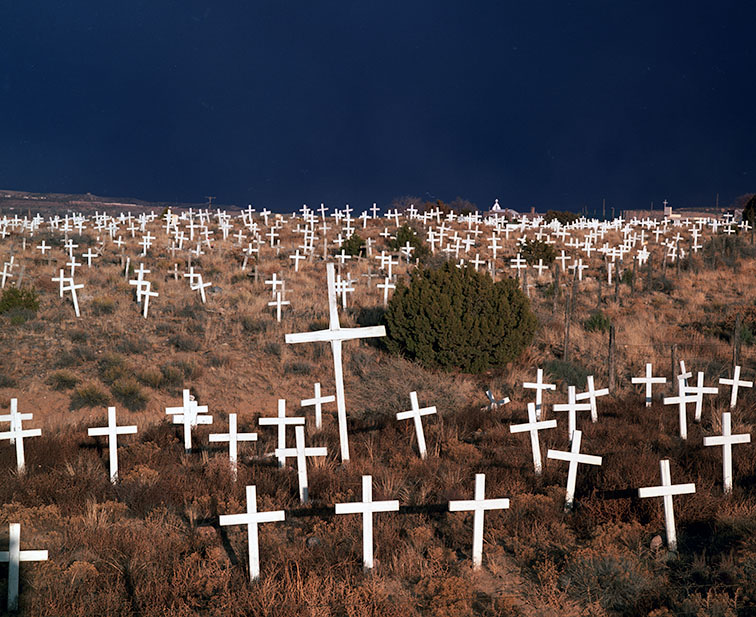
Just outside many badlands i worked in, there were rock art sites, bristlecone pines and cemeteries. The two cemeteries above were seen on my trips to Bisti Badlands, which is in an area of New Mexico that is rich in Indian ruins (Chaco Canyon), Navajos, energy production and scenes like this.
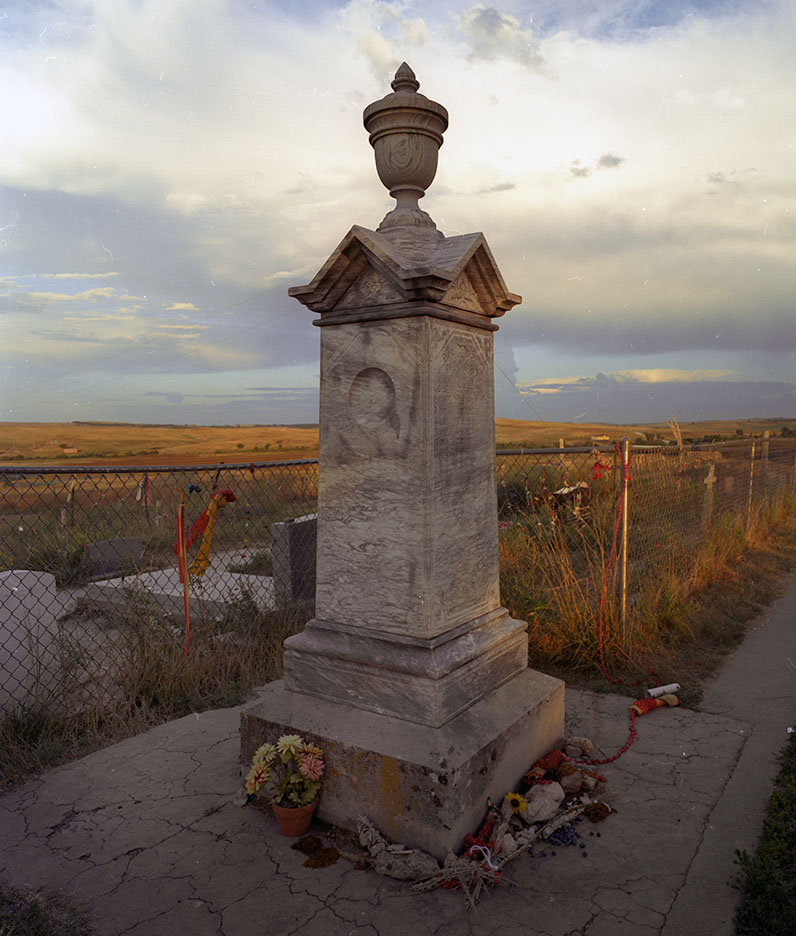
The memorial gravestone to the dead Lakota who died from the Wounded Knee Massacre site, that occurred across the road from the cemetery. There are some the names of the prominent figures killed here, such as Chief Bigfoot. All the names of the dead couldn’t fit on this marker, because well over 200 men, women and children are buried here.
There were forty wounded who survived and were among the witnesses, along with the many soldiers, who can testify to what happened here on December 29, 1890, in an event that was also the symbolic end to Indian resistance both spiritual and physical.
The cemetery is on the same high ground where one of the hodgkiss guns was placed and used in a massacre where victims were also found as far as two miles from the site, because they were hunted down by the soldiers. The same unit, the Seventh, these soldiers belonged to, was the same unit that that lost 268 men in the Battle of the Little Big Horn nineteen years previous.
No badlands have such rich and, even, tragic history, like the Big Badlands in South Dakota, as well as, the incorporartion of the landscape into their beliefs, as though the landscape were a massive tribal cathedral.