NIGHT FALLS (2001-2021)

INTRODUCTION

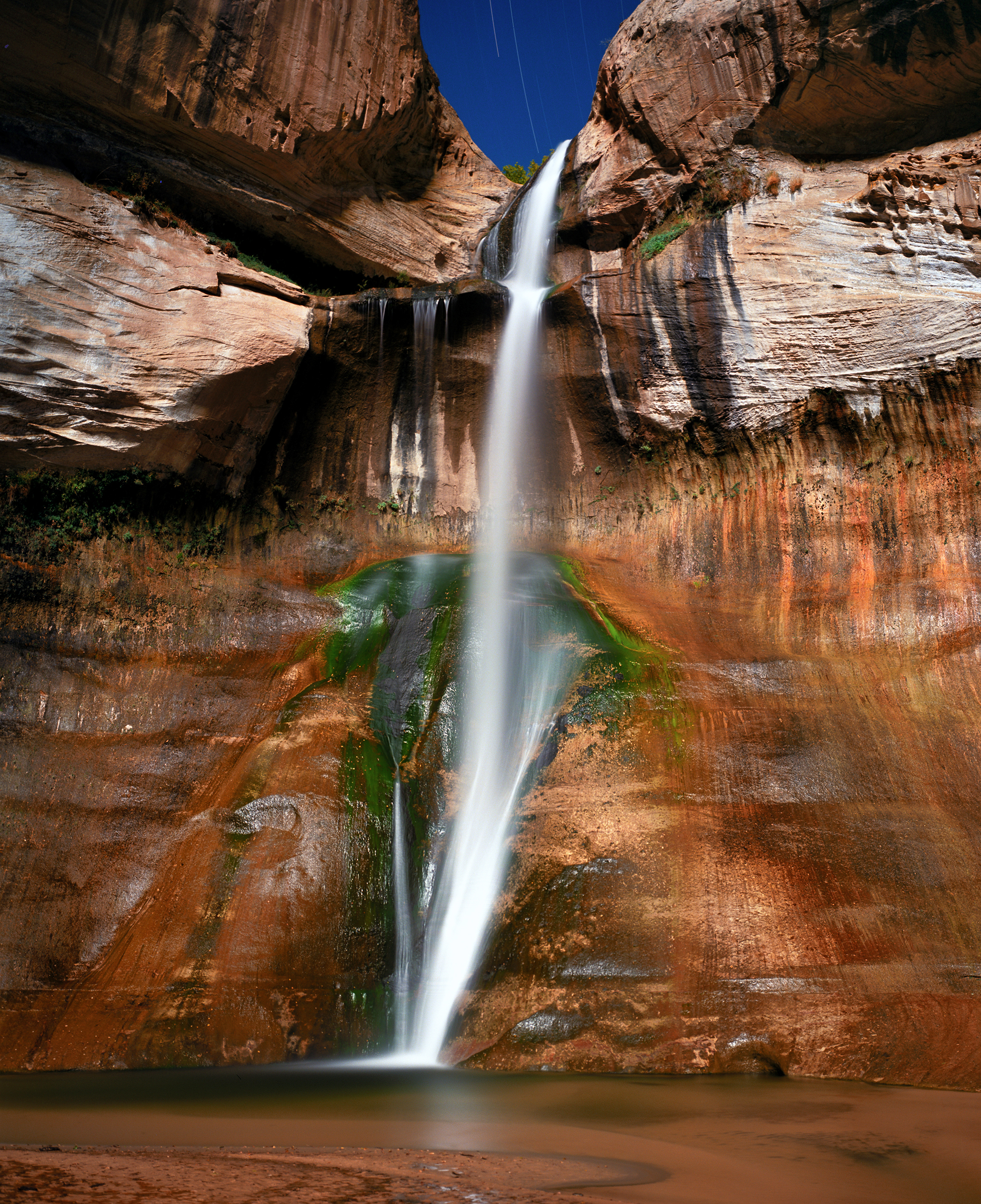
The work of  waterfalls illuminated by full moons began in 1998, when I photographed Calf Creek Falls in Utah under a full moon with Ektar 25 film in a 90 minute time exposure, deciding thatt, although it’s bounced sunlight, it didn’t look that way, and the light source would move during the shot. Confirming this, after printing samples, after shooting for years with out printing, seeing prints,

<img src=”https://realstill.com/uploads/books-the%20falls-calf%20creek-intro.jpg” alt=”” />

I got interested in waterfalls lit by a full moon, but the project would only begin in earnest, much later, 3 weeks after 9/11, and the towers falling, on the next full moon in October of 2001. Somehow this became a tribute to that event and I proceeded for the next 21 years, when I got a chance, to get out for a full moon excursion into waterfall country, which, for this project, occured, primarily, in my home state of New York and the beautiful neighboring state of Pennsylvania. I mentioned, “when I could” which is a mild reference to the nine years I was shut down with regards to my free will to shoot.Taking care of family for so long, that, while devastating, I don’t complain about it. However, the years I fought being displaced, with, of course, it, ending in being forced out, giving in and losing the war, and forced to move out of my legal home-for-life. Losing so much at the same time  – family, friends, having to start all over at the age of  sixty, including a move to the Bronx, out of Brooklyn, stunted the Falls project, but true to form, I began to shoot again in April, 2012, but had to sacrifice 2013, because Willet’s Point was being gentrified and 23 acres of shops was disappearing. The Iron Trinagle was gonna disappear by forced illegal displacement, something i had fought for ten years in art-fueled gentrification in my own neighborhood.

Although started in the typical photography fashion of trying to take in a lot of waterfalls over many states in a comprehensive, quality way, this book ended up truncated, as nine years were lost, and, now, due to incurable cancer, i have to spend my energy elsewher.

The Falls, I would rate as the most strenuous of my books. The timing and coincidences of geography, seasons and the moon meant that the leafless-less months, on clear moon-lit nights, with water flowing, hopefully, deeply in the streams, would be the time to make my move which also required to know the times that the gully, ravines and valleys would be lit by a quickly passing moon. This means that in a given year, I would have, maybe, six chances to shoot the falls, factoring in clouds and/or rain and snow, blocking out my light source, that was greatly narrowed, so it was a slog. Whatever the circumstances were, it’s disappointing to see that I never made it, particularly since cancer, which I hate to even, say, nested in my bile ducts.

It would have been the usual comprehensive and thorough look at a subject, only the outlook for continued productivity got hampered by the ten year hiatus to save my rightful home while trying to save my family from their inevitable fate, as well.

I busted my ass for this – 100 shots in a 21 year period, minus ten for bull shit i didn’t cause? And it was a bunch of tough, rough shoots – getting the moon to light up these splits in the face of the earth – narrow gullies, coolies, ravines, canyons, gulches and cuts, often in winter with everything frozen, dead or hibernating.

Technically, New York, has the fourth highest number of waterfalls in the United States. The top three are Washington, Oregon and California. Without question the top two waterfalls within New York are Niagara and Kaaterskill Falls. A death stigma around waterfalls, particularly high ones, and those with tremendous volume, are evident at these two sites, with Niagara also being far more known as a place for daredevils, or, Hollywood, with the likes of Marilyn Monroe, but, still, with risk and death as a present danger. Kaaterskill Falls, in the Catskills, is the deadliest Park land in the entire state, and, in the last 200 years, there has been over 200 deaths. It’s the highest Falls in New York, 90 feet taller than Niagara, and, unlike Niagara, you can simply walk right up into the stream, in fact, that’s exactly what you do when you’re far enough up from the falls to cross over on trails. With no fencing the area is completely natural and most folks just get too close to the edge.

Endless, at least those (most) that run, 24/7/365, and alive because they are changing, mostly by the amount and type of precipitation they carry over their edge. Waterfalls and streams, after rainfalls, clearly demonstrate the weight, power and expanse of the liquid substance, along with the sun, that creates and maintains life. The sun which, of course, can be seen and felt, but water is a thing that can be felt more by touch. It represents unstoppable, unrelenting, mindless force, and, over-the-edge. The waterfall kills, by its indifference with those who are careless, or take risks, by being too close to the edge, which, if you’re in the water, you don’t have to be any where near an edge to be sucked over, and fall.

Again, the death stigma around waterfalls, particularly high ones, and those with tremendous volume, are evident at these two sites, with Niagara also being far more known as a place for daredevils, or, Hollywood, with the likes of Marilyn Monroe. Kaaterskill Falls in the Catskills, is the deadliest stretch of Parkland in the entire state, and, in the last 200 years there has been over 200 deaths. It’s the highest Falls in New York, 90 feet taller than Niagara, and, unlike Niagara, you can simply walk right up into the stream, in fact, that’s exactly what you do when you’re far enough up from the falls to cross over on trails. With no fencing the area is completely natural and most folks just get too close to the edge.

Platteskill falls, the canyon or two, to the east of Kaateskill Falls, it’s such a beautiful falls, with a nice trail leading down to it, but, once I get down there, there is always something dangerous about it. If you attempted to cross the creek, particularly with a high volume of water, and, had to set up cameras on the Mossy, always wet, cliffs, on the opposite bank, you would feel that, and the soaking wetness of your clothes, tuning to ice, hikimg in and out of these places. This is where the creek begins its steep descent from the top of the Catskills, to valley floor, to the east, and, then, ino the Hudson River to the Atlantic.

The plunge of the creek is so steep through densely forestd chasms, that block light and access, that everything in there gets referred to as holes, the devil and the like. The entire Platte’s Cove area is named after the devil for good reason. Only God can help yout out there, if you fall, where, chances are, if found, it will be days. It’s so obvious, main reason why people die at waterfalls, or, falling, from carelessness, taking unnecessary risks or, even suicide and murder.

Curiously, I’ve yet to hear of a professional photographer being swapped over, and, if it involves taking pictures, today, it’s people who take selfies that are going over left and right.

When folks parachute for leisure they say that as they plummet to earth, time seems to stand still. I think if it fell over a waterfall it might be the same reaction, but, only those who survived, Can tell. There was a study on people in airplanes who survived extremely long falls up to 28,000 feet. That was the immediate and desperate attempt for the fall to end, followed by an entire life past before you in your imagination, and, finally basically, Bliss, before you hit the Earth. That, at least, is how a stewardess described fallen from an airplane, while strapped in a seat at 28,000, feet and landing in a river.

The risks were painfully evident, in 1971, when a friend, I went to high school with, Pat Rose, fell over Nevada Falls in Yosemite, and died in that waterfall’s 700 foot plunge. He and a friend decided to swim in the pool, just above the crest of the falls.

Shooting the falls during the longest nights of the year – in fall and winter, you begin to feel like Rod Steiger in the endless rain he had to endure, as, the tattoos he never asked for, came to life, during the The Long Rain sequence, in the movie, The Illustrated Man. The continuous wet, cold and noise is all natural, but not peaceful, comfortable or relaxing in the least, compounded by doing all the climbing and crossing water in the dark of long cold nights. I guess you could say that they are both, often, beautiful and dangerous. Shooting Calf Creek Falls in Utah on a warm summer night, which involved a two mile hike on sand and dirt trails up a box canyon to the falls, was both easy and almost pleasurable, except there was a mountain lion that had been hunting the deer in the canyon, which is what I would have done, since it’s boxed. A ranger warned me as I was entering the canyon at twilight, and, as I passed him, I smiled, and said, That’s what I came here for,” while all night keeping an eye out for the cat, and, actually, hearing rustling in the brush and trees as I walked up the canyon. Years later I would be struggling up ice and snow covered gorges in the middle of the night, with cramp-ons, sweating in 10 degree temperatures. In these times the falls would be muted, sometimes encased in ice, with only snow and ice providing the pure liquid fuel, devoid of sediments, powering downstream, uniting so strongly with gravity itself in a ceaseless pursuit of the bottom. Spruce Creek that feeds Kaaterskill Falls, eventually drains into the Hudson, and, that, into the Atlantic.

Ephemeral falls, only show up in big rains, and are intermittent, and, New York has lots of these often unmamed falls.

Full moon and waterfall work began in 1998 when I photographed Calf Creek falls in Utah under a full moon with the actor 25 film in a 90 minute time exposure.

After seeing the results, I got interested in waterfalls Lit by a full moon, but the project would begin in earnest ,weeks after 9/11 and the towers falling, on the next full moon in October of 2001. Somehow this became a tribute to that event and I proceeded for the next 21 years, when I got a chance, to get out for a full moon excursion into waterfall country, which, for this project, occurs, primarily,  in my home state of New York and the beautiful neighboring state of Pennsylvania. I mentioned, “when I could” which is a mild reference to the nine years I was shut down with regards to my free will to shoot. Taking care of family for so long, that, while devastating, I don’t complain abou it, however, the years I fought being displaced, with, of course, it, ending in being fully forced out, giving in and losing the war. Losing so much at the same time  – family, friends, having to start all over at the age of  sixty, including a move to the Bronx, out of Brooklyn, stunted the Falls project, but true to form, I began to shoot again in April, 2012, had to sacrifice 2013, because Willet’s Point was being gentrified and I had begun that project in 1998, and, it, too, had ended due to buy own struggles with displacement and having to start over again.

All that’s why, although started in the typical photography fashion of trying to take in a lot of waterfalls over many states in a comprehensive, quality way, this book ended up truncated as I began to shoot waterfall spots within three hours of my home continuously over these years, and, continuously when to certain sites, a lot.

The Falls, I would rate as some of the the most strenuous of my books equal to This Bad Land or Jerey Run, which are books that demand to go over one’s limits, and find a way. Another constant challenge was timiung, that would dictate when and where i needed to be for lighting of the falls landscape. The timing and coincidences of geography, seasons and the moon meant that the leafless-less months, on clear moon-lit nights, with water flowing, hopefully, deeply in the streams, would be the time to make my move which also required to know the times that the gully, ravines and valleys would be lit by a quickly passing moon. This means that in a given year, I would have, maybe, six chances to shoot the falls, factoring in clouds and/or rain and snow, blocking out my light source, that was greatly narrowed, so it was a slog. Whatever the circumstances were, it’s disappointing to see that I never made it, particularly since cancer, which I hate to even, say, nested in my bile ducts.

It would have been the usual comprehensive and thorough look at a subject, only the outlook for continued productivity goy hampered by the ten year hiatus to save my rightful home while trying to save my family from their inevitable fate.

I busted my ass like this – 100 shots in a 21 year period? And it was a bunch of tough, rough shoots – getting the moon to light up splits in this earth – narrow gullies, coolies, ravines and canyons, gulches and cuts, often in dead winter with everything frozen.

Endless, at least those (most) that run 24/7/365 and alive because they are changing, mostly by the amount and type of precipitation they carry over their edge. Waterfalls and streams, after rainfalls, clearly demonstrate the weight, power and expanse of the liquid substance, along with the sun, that creates and maintains life. Unlike the sun which, of course, can be seen and felt, water is a thing that can be felt also by touch. It represents unstoppable, unrelenting, mindless force, and, over-the-edge. The waterfall kills, by its indifference with those who are careless, or take risks, by being too close to the edge, which, if you’re in the water, you don’t have to be any where near an edge to be sucked over, and fall.

The risks were painfully evident, when a friend, I went to high school with, Pat Rose, fell over Nevada Falls in Yosemite, and died in that waterfall’s 700 foot plunge. He and a friend decided to swim in the pool, just above the crest of the falls.

Shooting the falls during the longest nights of the year – in fall and winter, you begin to feel like Rod Steiger in the endless rain he had to endure, as, the tattoos he never asked for, came to life, during the The Long Rain sequence, in the movie, The Illustrated Man. The continuous wet, cold and noise is all natural, but not peaceful, comfortable or relaxing in the least, compounded by doing all the climbing and crossing water in the dark of long cold nights. I guess you could say that they are both, often, beautiful and dangerous. Shooting Calf Creek Falls in Utah on a warm summer night, which involved a two mile hike on sand and dirt trails up a box canyon to the falls, was both easy and almost pleasurable, except there was a mountain lion that had been hunting the deer in the canyon, which is what I would have done, since it’s boxed. A ranger warned me as I was entering the canyon twilight, and, as I passed him, I smiled, and said, That’s what I came here for,” while all night keeping an eye out for the cat, and, actually, hearing rustling in the brush and trees as I walked up the canyon. Years later I would be struggling up ice and snow covered gorges in the middle of the night, with cramp-ons, sweating in 10 degree temperatures. In these times the falls would be muted, sometimes encased in ice, with only snow and ice providing the pure liquid fuel, devoid of sediments, powering downstream, uniting so strongly with gravity itself in a ceaseless pursuit of the bottom. Spruce Creek that feeds Kaaterskil Falls, eventually drains into the Hudson, and, that, into the Atlantic.

There are also many unnamed ephemeral falls, only show up in big rains, and are intermittent. The Empire state, as far as its numerous waterfalls, some quite high, large or wide like Niagra or Kaaterskill, is a great state for falls.

They use words like epic today, but this was a downright Sisphyean struggle, repeated many times, and, because winter was the best time for shooting the falls, with no leaves on the trees and the moon at its highest monthly arc, it became more challenging with ice, water, wind, snow and deep cold, the kind, when you climb up the mountain, and finally stop, you begin to sweat like you’re in the desert even though the temperature is 10° and then it freezes on your back.

Every time I shot Platteskill Cove Falls, I’ll cross the stream and always, no matter what the footwear, get soaking wet, then in out and drive to the trailhead for going up to Kaateskill Falls, go up, and behind the falls, circling around underneath a huge overhang, and coming out on the opposite side of the creek. The two mile hike to Silver Thread and Digman Falls, in snow, was hell, especially on the return trip after spending the entire night outside in 10° temperatures and climbing all over the waterfalls. It was bad enough that I eventually found a backway in, following the streams, a shortcut, that saved two hours of hiking. At Silver Thread I would bring three cameras and three tripods, and, all night long, move gear up and down the different levels of the falls. Some nights when I made the 2 mile hike back to the car, through snow that was about 2 feet deep, it was similar to the joy I would get in the badlands when I came back to my vehicle, where there was water, climate control, and comfort. Getting back on the road, soon the body and mind just became more alive and that thing, of my mine, that the demands of more extreme photography, would activate, and, I guess you could say, circulating blood and activated neurotransmitters, would cultivate such clarity, ideas, the five senses, clear and unbolocked, sensing. plus a sense of accomplishment, encased in an image, all that’s left, after a great experiece at night with the falls.

I spoke before about extremely strenuous activity, and extreme weather conditions and at night, produces a heightened awareness, and, also get in touch with physical and intellectual areas that are really activated, but, can produce some profile sensory and neurological effects. For myself, is the payoff for the job and the work, aunt Karen about the only really good thing I ever traded I work for. Kaaterskill Falls doesn’t have to be embellished with any sort of stories, because being what it is, is simply great. But one thing to be said about shooting it in winter, at night, largely frozen in a huge natural ice formation, it seems an apt memotial to the two hundred who died there, since, the arrival of Europeans, well as, a natural wonder.

The Falls began, in earnest, during the first full moon after 9/11. One of the last great memorials built in New York, recently, are the inverted fountains at the World Trade Center site. Two matching holes with water pouring in, honoring the Towers that fell like Niagra, and the people who fell or forced to let go and jumped to their deaths. The affects of gravity and water, its attraction and dangers, runs deep in this state.

VIEW the slideshow.