
The Queen of Links got me. I bit, reacted and ranted. Most of all, I wasted time I could have spent out with my camera and pen, experiencing and absorbing the Bronx in its layered world of difference. Truth is work, experience, and action. I reacted – maybe that was the plan. That is how the racket works now. You bait a man, wait for him to swing, then pin the whole case on the swing. Cheap shots can create opportunities, but not in the long run.
From Fordham Hill, where i lived for 13 years, the whole business looks thin. You look out over the Bronx and see a place that has taken hits, changed faces, changed languages, spent blood, and still kept its footing. Then along comes the educated PC crowd with its little boxes, labels, and moral filing cabinet, and it says life can be explained by sorting everybody into categories. That is not wisdom. That is clerical work dressed up as revelation. It is secular morality pretending to be art.
RealStill does not come out of seminar rooms, grants, panels, or those polished Manhattan institutions that keep telling the rest of us what life is and how it should be lived. No, it comes out of miles walked, years spent, friends met, conversations had, corners remembered, buildings lost, mills dead, bars gone dark, neighborhoods changing one storefront at a time. It comes out of experience. It comes out of action. I shoot he Cross Bronx Expressway for twrlve years and more to come, and the neighborhoods around it. No theory. Shoe leather.
The institutions had their chance. They could have told the truth while this identity racket was hardening into something narrow and mean. Instead, most of them went along. Why not? It was safe. It was fashionable. It kept the invitations coming. So history got shaved down. Experience got pushed out of the room. In came slogans, approved outrage, and moral upholstery nailed over the cracks. And it finally blew up in their face, her firing from Hunter, i’m sure some fancy institutions as well. Public art now, so it’s out in the open now – hatred.
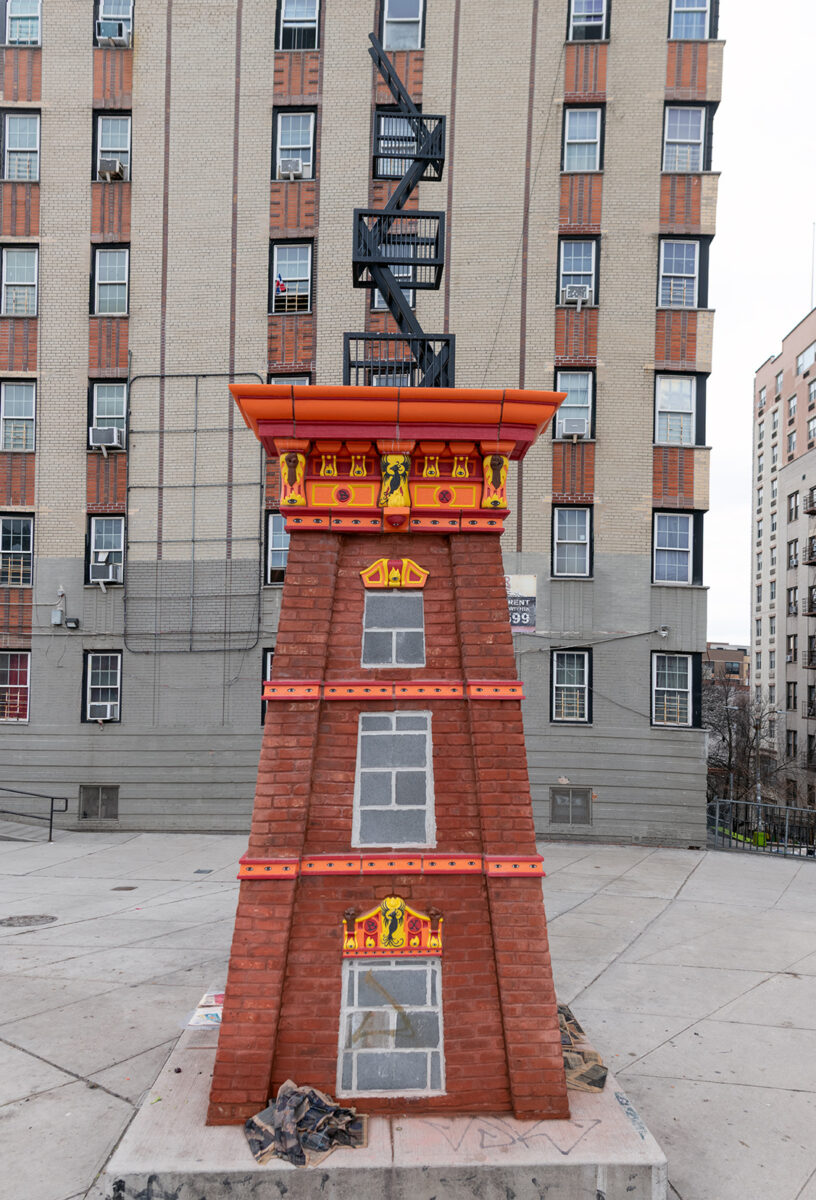
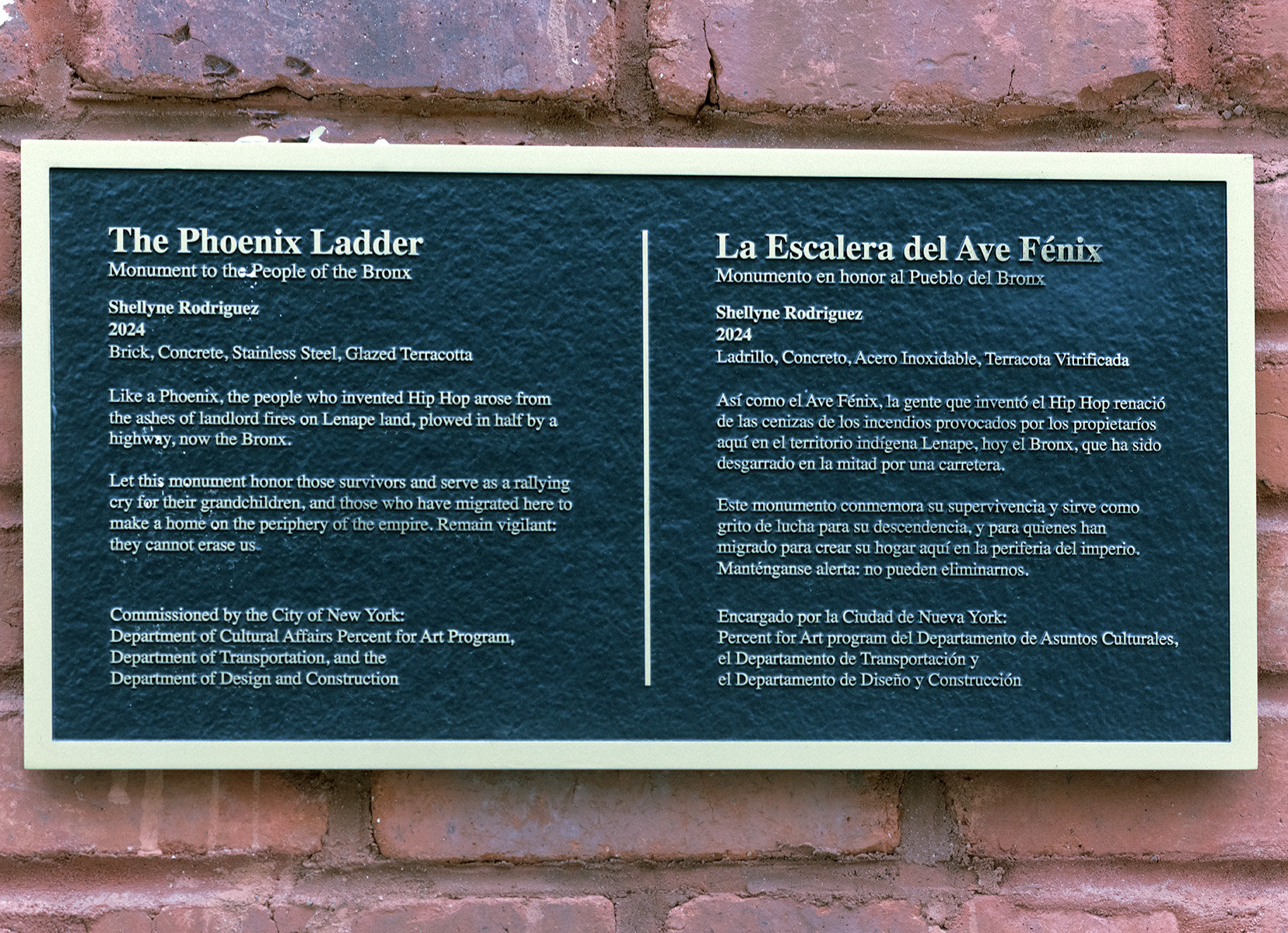
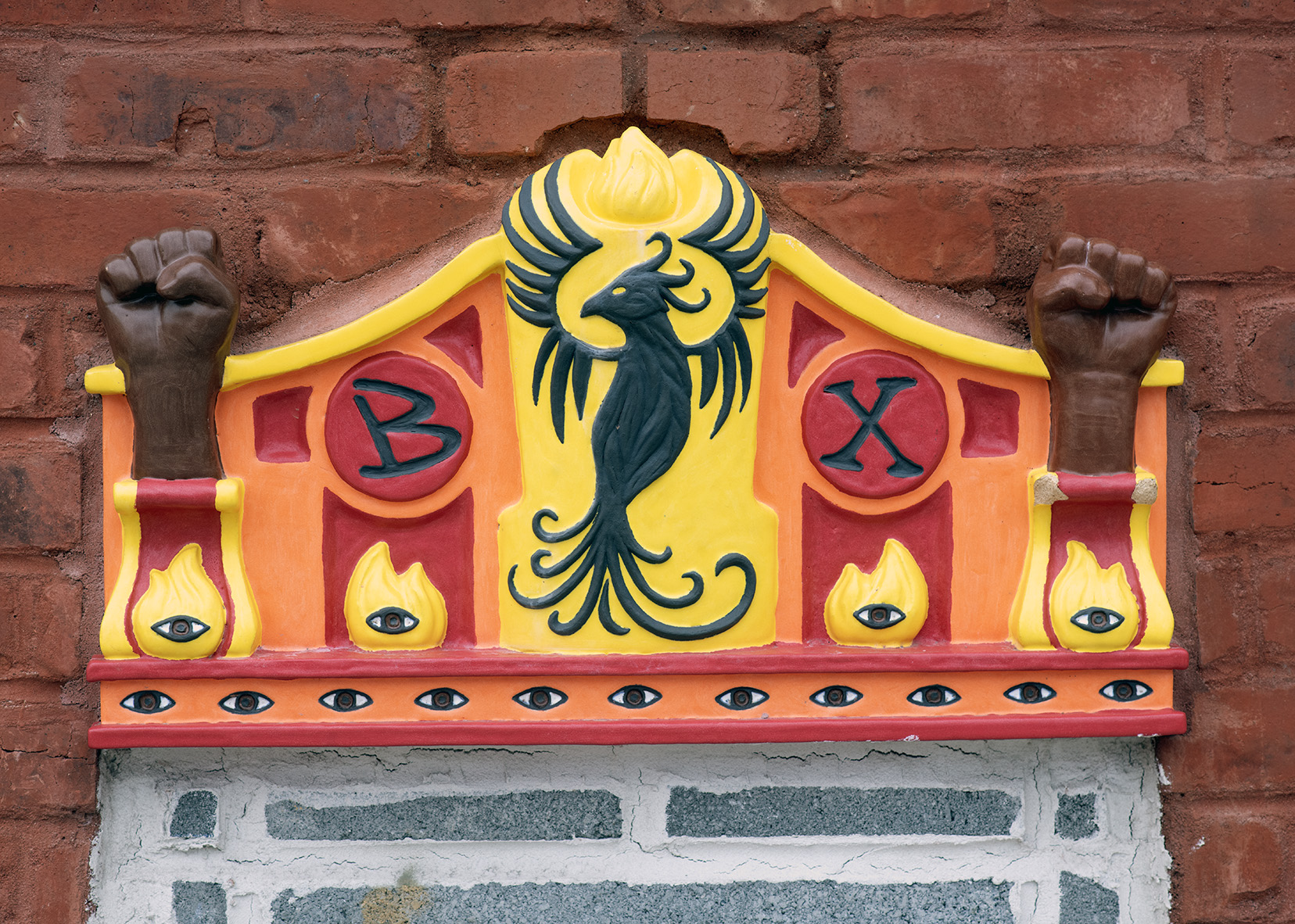
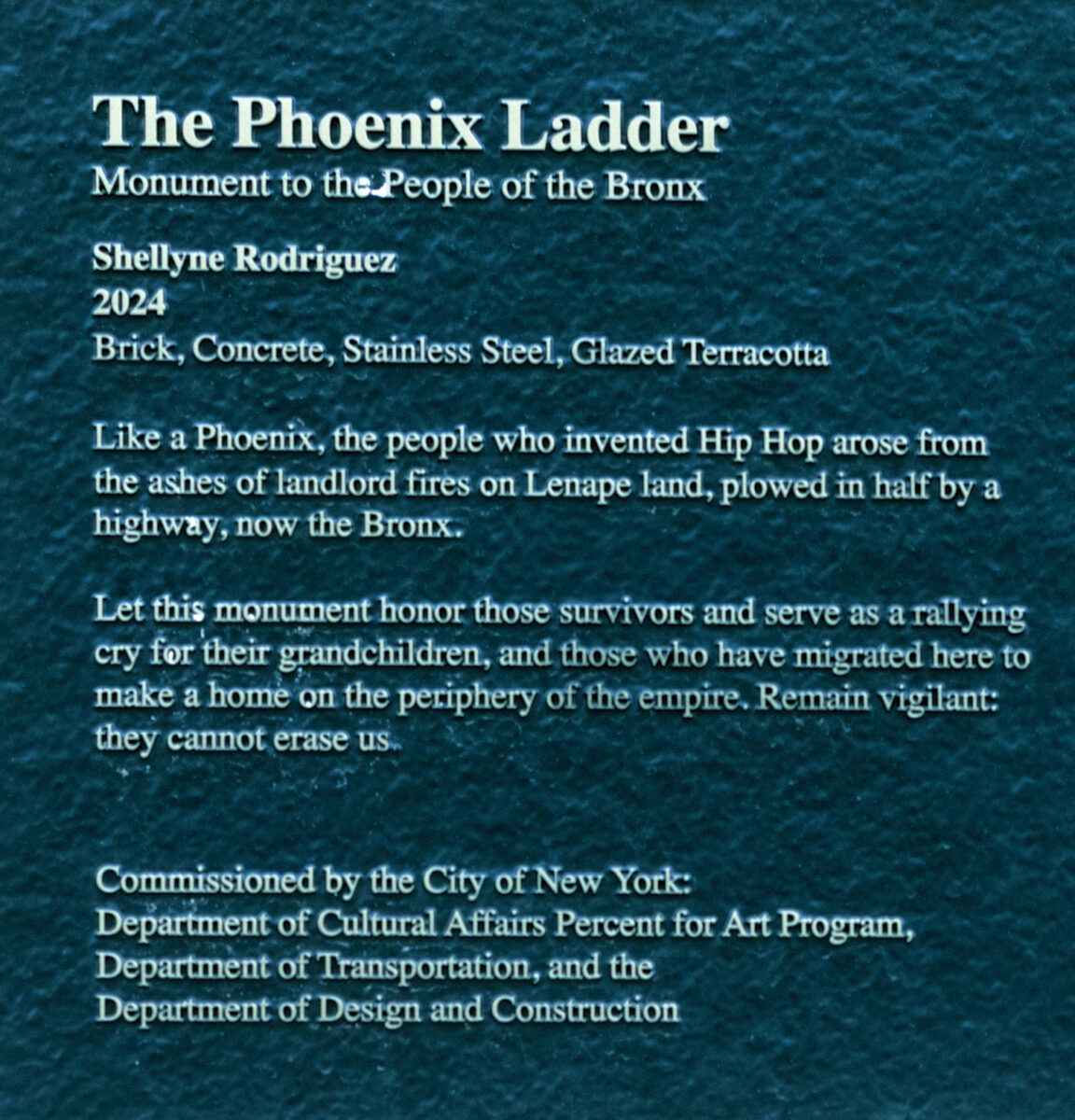
The Phoenix Ladder, by Shellyne Rodriguez, sits on the Grand Concourse two blocks north of the Cross Bronx Expressway. It cost taxpayers $476,000. It is supposed to be a monument to the people of the Bronx. But it is only a monument to certain people, reduced and approved in advance.
The Bronx did not begin in 1970. There is no honest gap in history that leaves only the Lenape and then jumps to rubble and noble suffering. Before the approved story of ruin, this was already a big, tough, ambitious borough, and before it was a borough it was part of a colonial and then revolutionary history that mattered. A Swede named Jonas Bronck arrived in the 1600s. The land later passed into the hands of the Morris family, by vitrue og the King, and from there into the long, layered life of what became the Bronx.
The Morris family played a major role in the birth of America, the Declaration, and the Constitution, which gave people like Rodriguez the freedom to say whatever the hell they want, including using a work of public art to chop a huge segment of Bronx history out of the picture.
The Grand Concourse was not just a boulevard. It was a statement, modeled after the Champs-Élysées, not Cairo. The borough was built by dozens of immigrant nationalities, religions, neighborhoods, and ways of life. They did not form some blank white lump. They built streets, parishes, storefronts, schools, unions, social clubs, and a whole cultural engine that ran through film, music, writing, style, and speech. Dion. Pacino. Doo-wop. Kubrick. The Reiners. Ralph Lauren. DeLillo out in Co-op City banging out books. It is a long list. That was the Bronx in its golden years, before the fall, before the simplifiers came in later and cut the story down to one approved chapter.
And that history also included Black life in a very big way. The first Hispanic group to reach the Bronx in major numbers, of course, was Puerto Ricans after theinitial building of the CBE. Along with everyone else came the Black Bronx and what the world later called the Boogie Down, the Bronx of hip-hop, breakdancing, new slang, new style, new sound, new swagger, and graffiti. But none of it rose out of empty air. It hit an older borough already thick with memory, conflict, striving, appetite, and form. It did not erase what came before. It collided, they didn’t fit but both are equal in importance and i can prove it since we all know hwo built the place and who the residents were from the 1600s until 1945.
Let me be clear: I love the Boogie Down and what it represents. I was there from the get-go. I know what it meant and what it gave the world. But the Bronx is larger than even that. It includes the golden age, when the borough grew like crazy and produced a culture of enormous force in movies, music, literature, style, and speech. It includes the earlier Bronx too, the colonial Bronx that evolved into part of the democratic break of the American Revolution. The old immigrant Bronx, the Black Bronx, the Puerto Rican Bronx, the Boogie Down Bronx, the Bronx of hustle, invention and survival — all of it belongs. That is history and truth. Once you separate one side of that coin from the other, you are no longer talking about the Bronx. You are talking about a slogan.
That is the part the official version never gets right. It likes clean lines and approved victims. It likes a simple mural and a simple sermon. What it cannot handle is the handoff, the argument, and the accumulation: the old immigrant Bronx layered into Black, Puerto Rican, Dominican, African, Caribbean, Irish, Jewish, Italian, and Albanian life. The Jews still hanging on in Riverdale. The Irish in Woodlawn and Kingsbridge. Italians and Albanians in the east. That is the borough. Not a slogan. Kingsbridge divided equall ampogst Irish and plain Whit, Domincan and Black
Of all boroughs, this one moves. That is the history of the Bronx. People come, get a foothold, and move on if they can. It began filling up after joining New York City, when the slums of Manhattan, especially the Lower East Side, emptied upward into bigger, more ventilated apartment buildings. Then came more nationalities directly from abroad. Puerto Ricans, born American, once dominated much of the Bronx. Now Dominicans do, with Mexicans a major presence in neighborhoods. The borough keeps turning over. It does not freeze for anybody’s theory.
I came up in the 1960s, when the better instinct, even with all the noise and mistakes, was unity. I remember the John Sinclair rally at Chrysler Arena in Ann Arbor. Sinclair, the leader of the Black Panther party, was busted for two joints and got 10 years in prison. Radicals, musicians, loudmouths, true believers. Lennon, Yoko, Bobby Seale, Eldridge Cleaver, Angela Davis, Abbie Hoffman, Huey Newton, Jerry Rubin. Nobody worth listening to stood there explaining that solidarity had to stop at the border of identity. That was kid stuff. The point was common cause. The point was that people with different backgrounds could still recognize the same crooked deal when they saw it.
And the deeper point was power. Unity creates power. It creates democratic force. You even saw a version of that during the George Floyd summer, when all kinds of people came together in the streets. Black, white, Latino, Asian, Jewish, every kind of person. That is how change gets leverage: not by shrinking life into smaller and smaller boxes, but by building a coalition big enough to matter.
So no, I am not taking lessons from some academy that throws people out one year and lectures the country on moral vision the next. I am saying something plainer. Reducing life to identity is a crooked simplification. It insults history, insults art, and insults the people who actually lived the mess instead of theorizing it from a safe distance.
Not maybe. After living it, it is one big soul, like Preacher Casey said. That comes from experience alone. But once you chop that soul into categories and run it through a highly subjective artistic mind soaked in political correctness and identity politics, it comes out looking exactly like this: narrow, self-important, and false. That is the usual game of the educated class, mostly white, forever inventing language to criticize other people’s lives from a safe distance.
“Latinx” is the perfect example. The word gets pushed hard in polite circles, but hardly anybody in actual life uses it. The people living around this thing on the Grand Concourse sure as hell do not.
And while I’m at it, I’ll tell you another thing. “People of color” is not something I have heard in the hood, the working class, or the slum. I have heard educated white people and educated Black people use it. Out in the street, the language is different. The life is different. The categories come from somewhere else.
Every time I hang around the Grand Concourse in this area, not for this Phoenix business but for any shooting in the neighborhood, I wind up having long conversations about the piece with everybody: vendors, passersby, neighborhood people, people from all over the city. None understand it. None like it. My suggestion is simple: take the $476,000 and hand it out to creative people in that neighborhood. You could go to almost any neighborhood in the Bronx and find hustle and creativity right there in the street. That would have a better chance of being truthful.
And it is in the wrong place. It sits on the Grand Concourse, which did not burn the way the legend says the Bronx burned. Plenty of nearby streets held on. If the artist knew Bronx history, or cared to, she would have put it in Longwood or Mott Haven, where the fire really did its work, and where the old ruins have now been buried under clean new buildings, sealed windows, and expensive forgetfulness.
Condo towers rise in Port Morris. Even 138th Street is getting built up at the west end. The real scar of the Bronx now is not just the old project blocks. It is the collision between slum-clearance housing and new luxury development, where people making ten or twenty times the neighborhood income move into towers planted right beside the poorest. Once Brooklyn and Manhattan got built up and overpriced, the Bronx became a giant opportunity for investment.
That is where her “phoenix” belongs. Because what she ignores, maybe the biggest power of all, is money. Redevelopment. Capital. The Bronx’s biggest story now is not identity politics. It is outside money remaking whole sections of the borough for people who never came out of its history but are happy to cash in on its geography.
“Phoenix rising”? Fine. Then tell the truth about what is rising.
Not some politically approved rebirth, but a borough being remade again by capital, speculation, and the steady pressure of people with more money than memory.
Close to my home at Fordham and Sedgwick, they built a beautiful $50 million residence for the homeless. It has solar panels on the roof, a gym, climate control, and handsome little apartments. Highbridge tells the same story. Rising beside that wild tangle of ramps, bridges, and the Cross Bronx Expressway, it stands in one of the most dramatic places in New York, perched on the east bank of the Harlem River, with some of the best views in the city.
I know because I wanted to live there myself. I wanted to live there so badly that, for a minute, I was blinded to the fact that I never could. It was not built for me. It was built for the very poor, the homeless, the addicted, the people at the far edge of the trouble.
And that is the point. The Bronx has changed, and it is still changing, while people go on talking as if they are trapped inside one old symbol: the Bronx burning, the same stale sermon about the Cross Bronx Expressway, the same easy racial script that leaves out the fact that many of those displaced were Jews, Irish, and Italians, not the later population now dragged backward into the story for moral effect.
Meanwhile, right in front of their faces, another Bronx has been taking shape: a Bronx where public sympathy, public money, and public will are poured into expensive new housing and programs aimed at people in the deepest trouble, while the working poor, the ones who are not homeless, not addicted, not dramatic enough for official pity, keep getting squeezed, overlooked, and pushed aside.
The Bronx does not need another identity sermon from people who flatten its whole history into a cartoon. It does not need the old white ethnic Bronx erased as if dozens of nationalities, religions, neighborhoods, and ways of life were all one thing. It needs somebody honest enough to say who got burned, who got rich, and who is still standing in the smoke while the past is buried under the biggest building boom since the 1930s.
That is the Bronx story now. Not the old fire symbol alone. A borough changing in plain sight while people are still staring at the smoke from fifty years ago, while the whole place gets rebuilt right under their noses.
The symbol took over the reality. “The Bronx is burning” became such a powerful line, and the Cross Bronx Expressway such a dependable villain, that people can wind up looking at the borough through old smoke. The symbol stays frozen. The borough does not. It keeps moving.
Meanwhile, the living Bronx is right there in plain sight. Newer immigrants from Africa, the Caribbean, Mexico, Albania, and elsewhere are not standing around brooding over some old mythology of fire. Most are too busy speaking their own languages, raising kids, chasing work, paying rent, trying to get a foothold in America, or just surviving another week. And on both sides of the Cross Bronx Expressway, the people look much the same anyway. The ethnic mix runs across it, not away from it.
The life of the borough kept flowing. Then there are the old-timers, people like me, who have lived long enough to remember the layers, the fall, the reinvention, the whole damn thing.
The smoke made a better story. The Bronx kept living.
What her version cannot handle is the handoff, the argument, and the accumulation: the old immigrant borough layered into Black, Puerto Rican, Dominican, African, Caribbean, Irish, Jewish, Italian, and Albanian life, all of it surviving in different corners and mixing into something larger than any slogan can hold. That is the real borough, and the real borough is always the whole. To lop off three hundred years of history and replace it with a thin morality play is not insight.
It is blank rage posing as seriousness.
In this crazed America, it is worth remembering that families like the Morrises were the billionaires of their time: landed power, aristocratic power, old power. Yet the history is more complicated than the cartoon. Gouverneur Morris, who wrote the words “We the People” in the preamble to the Constitution, came out of that world. The Morris family once controlled an enormous stretch of the future borough, and Morrisania was no accident of naming.
But here is the radical break that the simplifiers cannot handle: the colonizers stopped colonizing. They became revolutionaries. Out of that old world of hierarchy, rank, and inherited power came a thing called democracy, unheard of in its force at the time, and with it the explosive demand that this new country would have to be made out of more than one’s own kind, more than one’s own class, more than people who looked alike, prayed alike, or came from the same blood. “We the People” was the break.
Their holdings reached across huge sections of the place, and from those estates came Mott Haven, Highbridge, Morrisania, Claremont, University Heights, Belmont, and the rest, as the land was broken up, sold off, and absorbed into the city. That is not an absolution of power. It is history. And history is always more tangled than the symbol-peddlers want to admit.
I know something myself about displacement. I spent fifteen years being pushed out of Brooklyn, against my will and against the law, so I do not need a lecture on colonizers from somebody trafficking in easy shorthand. My point about the Morrises is not that old power was pure. My point is that the men who gave us “We the People” were the aristocrats and billionaires of their time, and they did something enormous: they stopped being colonizers, became revolutionaries, broke with empire, and founded a democratic country. That is the break.
And the Bronx is one of the things that came after that break: not a slogan, not a morality play, not a sermon in metal on a traffic island, but a borough built out of wave after wave of people living, working, building, fighting, praying, hustling, and moving through history.
Miss Rodriguez reduces all of that to something crude, self-righteous, and false, and then taxpayers are asked to underwrite the insult. Of course, according to the usual script, anyone against her work is supposed to be right-wing. Nonsense. Most people I know who are against it are anything but. And if the neighbors do not like it and do not understand it, they are the ultimate critics. Not this purest form of PC and Identity Politics.
Frankly, she might have made better art by giving the money to the people in the neighborhood and leaving the sermon at home. Because I guarantee you that, like in most neighborhoods in the Bronx, the locals are extremely creative and deeply into the hustle, the creative hustle that built the new Bronx.
The trouble is that the symbol made a cleaner story than the truth. The truth is messier, more crowded, more human: old memory, new arrivals, working people, addicts, hustlers, families, luxury towers, subsidized apartments, old names, new tongues, all of it jammed together and moving at once. That is the place. That is what she cannot see.
And that is why a few dollars handed straight to the people living there would have been better art than this empty lecture in text and form, cooked up in Manhattan institutions and brought back uptown as revelation.
Funded by We the People.