
I’ve listened to the Bronx Rant about its east/west trench carrying I-95 – it’s a border and a barrier to a better life and housing and its racist infrastructure which popped up big-time with the Biden asministration and pete Butegieg. Here’s my rant abouth that rant.
I lived most of my life three blocks from the BQE in Williamsburg. The road ran straight through the neighborhood on its way to Queens. It did not bend. It did not apologize. It removed the original Our Lady of Mount Carmel at Union Avenue and left behind a small industrial triangle between McCarren Park and the highway. That triangle was mine.
The BQE cut through working neighborhoods as an elevated scar. When it reached Brooklyn Heights, it was placed on a cantilever so the promenade and the view would remain untouched. If anyone needs a lesson in Robert Moses and class, start there. Concrete behaves differently when wealth is involved.
In the 1980s, pollution in Williamsburg and Greenpoint was not a theory. It was daily life. The Brooklyn–Queens border, west from the East River, was the most contaminated waterway I ever photographed. Backyard vegetables carried toxins. All men on our blocks developed cancer and died in their sixties and early seventies. I did too, but did not die yet, three years after being told i would be dead in one year. Nobody called it infrastructure racism. It was just the air.
The Cross Bronx replaced residential streets. Those blocks were homes, not factories. But violent decline was not unique to that corridor. Industrial neighborhoods are usually first to be ignored. Only recently has that neglect been given a moral brand.
I stayed in Williamsburg because it was cheap. No romance. The building sat in a heavy industrial zone where homes and factories mixed without ceremony. When the BQE carved its triangle, it created a leftover district no one preferred. McCarren Park was a ruin. The Navy Yard still functioned. Greenpoint burned waste. The air smelled like work.
Williamsburg did not change because of conscience. It changed when seventy-five square blocks were rezoned from industrial to residential with almost no height limits. The sewage plants were removed. The incinerator shut down. McCarren Park was restored. The Moses pool reopened. A billion-dollar digester stopped the stench drifting over the neighborhood. Pollution left when capital arrived.
That is the geography. Everything else is argument poured over concrete.
The Cross Bronx Expressway has since been crowned the flagship example of “racist infrastructure,” a phrase that now travels internationally as settled fact. In 2021, while I was photographing along the corridor, a group of young men approached me. They were from Peru, studying architecture and assisting efforts to cap the expressway.
Before they finished explaining, I said, “And of course, it’s racist infrastructure.”
They smiled. All nodded. Yes.
The theory had gone global. People were flying in to study it and help correct it. I tried to explain the sequence. I stopped. The script was already written.
The irony was hard to miss. They were speaking Spanish, a language imposed on their ancestors through conquest. Peru is Spanish, Indigenous, or both because of empire. And is nothing like our history. Spain’s wealth grew from centuries of extraction backed by naval power. Entire civilizations were reordered. That is a civilizational rewrite.
Yet no one is demanding reparartions from Spain.
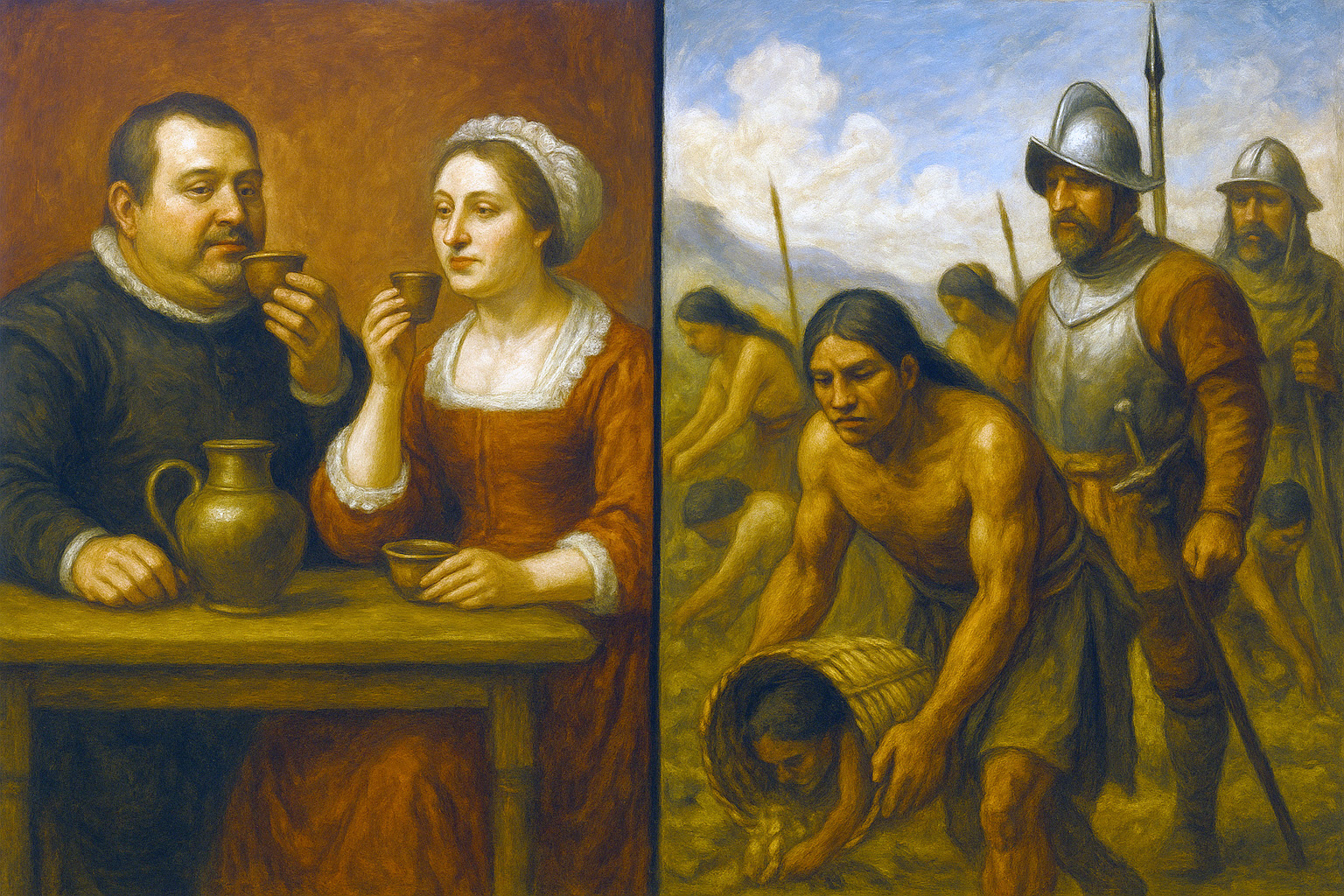
Can pictures change things? Usually not, but can plant a seed. Even realistic illustrations before photography might turn folks on to something simple like where and how does your beloved cocoa plant make it to Spain.
America has its own record of displacement and screwing up. Dodger Stadium erased Chavez Ravine. Love Canal required demolition and remediation. In Johnstown, a poorly built dam killed 2,200 people. Disasters, relocations, toxic legacies. None unique to the Bronx. None reducible to a slogan. Shit, even Linoln’s beloved son died of typhus from the water in the White House. By the way Boston’s Big Dig, another expressway through the densest sections of an old city, is by far the most expensive of these urban infrastructure projects at 22 billion dollars and 16 years of construction. It did not displace people like the cross Bronx Expressway, but was known for its tremendous cost and corruption.
The the Cross Bronx Expressway did damage. No serious person denies that. But the damage sits inside a web of class, capital, migration, municipal collapse, and timing. The route was drawn in the postwar boom. Housing stock aged. Redlining hardened into policy. Industry drained away. The city’s fiscal crisis hollowed services. Insurance incentives made arson profitable. Drugs moved in. Middle-class flight accelerated.
Each force alone was strain. Together, at that moment, they compounded into collapse.
Timing matters. Infrastructure does not operate in isolation. It intersects with economic cycles, political decisions, and demographic shifts. In the Bronx of the 1960s and 1970s, those forces aligned in the worst possible way. But also places like co-op city and the Bridge apartments over the Manhattan trench began to sprout up offering alternative housing. Of course, this was initially housing populated by white, which, of course, eventually became Black and Dominican.
I was not there in 1946 when the route was drawn. I was there in the 1970s. Tenements along the expressway were abandoned. Windows boarded. Plywood painted to resemble curtains and flower pots, as if optimism could be faked with a brush. Blocks hollowed out long after the bulldozers left. The destruction did not arrive in a single decade with a single man and a single plan. It accumulated.
To compress all of that into two words may feel satisfying. It assigns villains neatly. It travels well. But compression is not history.
History is sequence. And sequence matters.
The Cross Bronx Expressway was not some casual scar slashed across the map. It was the first real attempt to run an interstate through dense, existing urban neighborhoods. That mattered. Engineers weren’t playing SimCity. They were solving topography.
The route through the West Bronx begins at the borough’s highest ridge. From there, the road is cut deep into a trench down toward Jerome Avenue. It then climbs again through a tunnel supporting the Grand Concourse and its subway lines. Around Webster Avenue, the trench fades. The roadway becomes elevated, then passes beneath a playground and school that were built over it after the fact. Beyond that stretch, it is no longer the dramatic trench people photograph. It becomes, structurally, unremarkable.
There were only three realistic engineering choices in 1948: tunnel, cut, or elevated. Each had cost, displacement, and structural limits. The cut was not chosen out of cartoon cruelty. It followed the ridgeline.
One fact rarely mentioned: only three cross streets vanished entirely. The mythology suggests a wall that sealed off the poor from moving north. That is too blunt. The Bronx north of the expressway was not a gated Eden blocked by concrete. Walton, Morris, Valentine, Webster, Park Avenues lined with the classic six story brick walk-ups – concrete valleys all the way up to Kingsbridge Road, from Mott Haven and the true South Bronx, continually inhabited with working-class immigrants from many nationalities and the Cut really had no say in that.
Consider Mott Haven. It was largely built between 1880 and 1920, when the Bronx population was just 89,000. Its housing stock was suburban in scale, often middle and upper class, architecturally striking. The later collapse of the South Bronx cannot be explained solely by a highway trench.
If we are serious, the harder question is this: who left, who replaced them, and who bears responsibility for the deterioration that followed? The period of massive decline and arson-for-hire came decades after construction. Population shifts, redlining, insurance incentives, municipal neglect, landlord abandonment, and economic collapse all played roles.
Robert Moses’ deeper crime was not merely building a road. It was slum clearance policy that tore through streets in places like Mott Haven, Melrose, Soundview, Highbridge, Morrisania, etc. displacing residents in the name of renewal. As far as I’m concerned, this is a far greater urban sin then the Cross Bronx Expressway. Especially in terms of what was lost.
The Cross Bronx Expressway was a brutal intervention in a living borough. But turning it into a single-cause explanation for the South Bronx’s collapse oversimplifies a far more complicated unraveling.
History deserves sharper tools than slogans.