
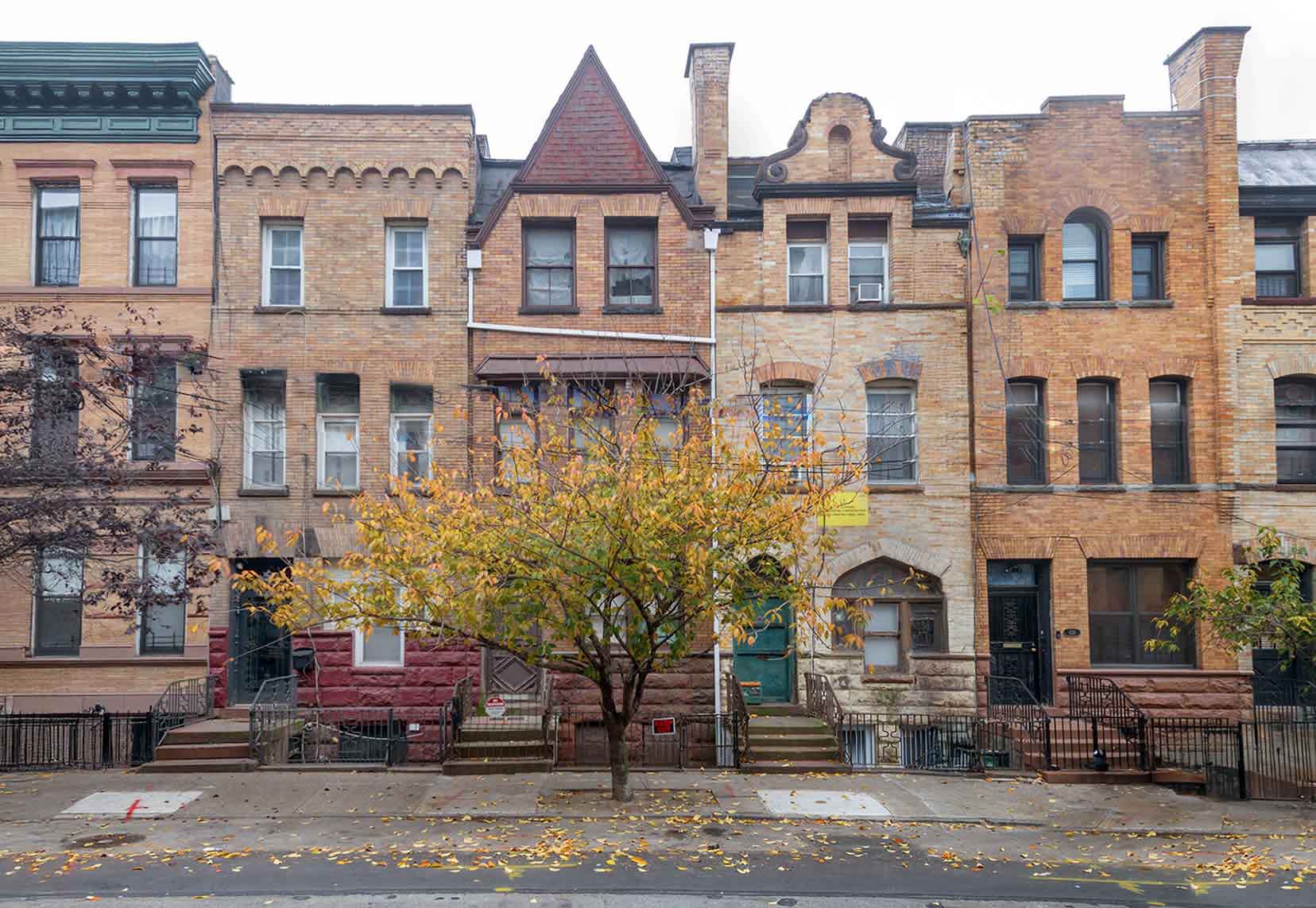
The Bertine block, was named for developer, Edward Bertine, who built his home and nine other Queen-Anne style row houses between 1891 and 1895 on E. 136th St. in Mont Haven. It was Mr. Bertine’s first venture into building homes, and he managed to hire George Keister as architect, who built many notable structures in Manhattan, like the Selwyn Theatre.
The population of the Bronx was 89,000 when rowhouses of this style were built, mostly below 149th St. when the Bronx was largely farms and single homes. The borough grew to 1,200,000 by 1930, and would become known for its huge apartment buildings with much larger units, and, with cross ventilation The era of rowhouses, designed like the Bertine, and many others below 149th St. ended quickly. Open land, with tremendous population growth, eventually led to apartment complexes, like Coop City, with 35,000 units, to be constructed.
The South Bronx, has long been associated with urban decline. The name itself, South Bronx, was used by sociologists to describe a small pocket of poverty on Brown’s Place, in Mont Haven, not far from the Bertine Block, one hundred years ago. Authentic and unique, the Block, survived waves of urban decline and, now, redevelopment. “Slum clearance” was used to build huge housing projects in Mott Haven, and the expressways, that separated, Port Morris, where the jobs were, and more residential Mott Haven, where people lived. Mott Haven streets disappeared by eminent domain, burning and abandonment that had first established itself here, and began to move north in the 1960s.
The Bertine block, survived the historic rise, and decline of the Bronx, and even its gentrification, with clusters of luxury, residential towers along the waterfront, and new housing all over the borough, signaling another upturn in the Bronx saga.
The block remains as rare living history. Nothing has changed, not just the architecture, but the same type of hard-working owners live there long-term, sometimes generations, and take care of it. Across the street more hard-working people live in a row of now working-class tenements built as fine rentals, and further divided into many more units. The block, unreconstructed, void of gentrification, on an architectural and class level, is still in fine shape with its South Bronx patina untouched, albeit a notch or two down, from when these streets were considered desirable. The Bertine Block remains authentic, providing a clear view on a time when Mott Haven became urban, 150 years ago

Freshly built with new trees planted.
https://s-media.nyc.gov/agencies/lpc/lp/1900.pdf


At the corner of Willis Avenue, attached to the deli is a picture of Carol’s mother and father who lived initially on the north side of the block, but would later buy a home in the Bertine Row, as they walk home down the block. In the background along Willis Avenue, the old blocks were replaced by housing projects.

https://www.nytimes.com/2011/03/20/realestate/20Habitats-south-bronx.html
Carol, an owner that has been on the block longer than anyone, and, her parents originally owned the home where she grew up.


North side of the Bertine Block, On the north side of the block is a row of rentals directly across from the Bertine. Not yet gentrified, this row still houses hard-working people, more than ever, considering that considerabley more units have been added through renovations inside some of the buildings.
Bicycles line the stairs of the row on the north side, obviously, a haven for essential workers.
 The north side of the Bertine block – “By the final years of the nineteenth century the construction of single-family rowhouses was declining in Manhattan and in the Bronx. In the Bronx many two-family houses were erected, such as those in the Clay Avenue, Longwood, and Morris High School historic districts, but multiple dwellings -tenements, flats, and apartment buildings — became the most common type of new residential construction. There are eight tenements in the Bertine Block Historic District, built in two groups of four – Nos. 429 to 435 and Nos. 437 to 443 — between 1897 and 1899. Although each group was commissioned by a different client, all were designed by Bronx architect Harry T. Howell. Howell is another local architect about whom very little is known, except for the fact that he first appears as an architect in New York City directories in 1897, and he maintained an office at least until 1918.
 Each of the five-story tenements is faced in brick trimmed with Renaissance-inspired detail in
stone and terra cotta. The window openings contained non-historic window sash at the time of
designation. Each building was planned with eleven apartments, two on each floor, plus an apartment
for the janitor in the basement. The buildings can be classified as “old law” tenements; that is, they were
planned following the guidelines established in the Tenement House Act of 1879. 21 This act required
that every room in a tenement (generally defined as any residence with more than three apartments, with
each household having separate cooking facilities) have a window looking onto the street, a rear yard,
or an air shaft; these air shafts were extremely small and offered little light or air to apartments on most
floors. The eight tenements in the historic district contained five-room railroad flats. 23 Each building
had a public hall, but the individual apartments did not have halls. Rather, rooms were lined up one
behind the other, much as cars are connected on a railroad train. The kitchen, bathroom, and dining
room were located in the rear, the parlor in the front, and two bedrooms in the center looking onto tiny
air shafts.
Howell’s eight tenements generally attracted households that were less affluent than those residing in the nearby rowhouses. Heads of households (generally men) living in these buildings included those listed in the 1900 census as salesman, cook, painter, clerk, bookkeeper, telegraph operator, confectioner, carpenter, machinist, and railroad clerk. Wives generally worked at home. Many of the children were at home or were attending school, but others, including children as young as fourteen, were employed. residents were both American-born and immigrants (the largest number of immigrant residents were from Germany and Ireland); most of the immigrants were adults whose children were born in this country.”