
It’s an archive in book form. With 600 shots the book won’t qualify for a nice coffee table art/documentary book, but, i’m capable. Perhaps, one day i’ll do that. If you want to see a nice book edit, view Twilight Town/Fall Town Mix which refines those two books into an art book.
Dirty Old Town is the first of a trilogy of books that views one city in the context of loss and the Rust Belt. Dirty Old Town is America’s first Rust Belt book, shot on Kodachrome 25, between 1977 and 1988. The city is purposely left anonymous, so that it can represent all of the many towns and cities that went through the same scenario. And not to stereotype it any further.
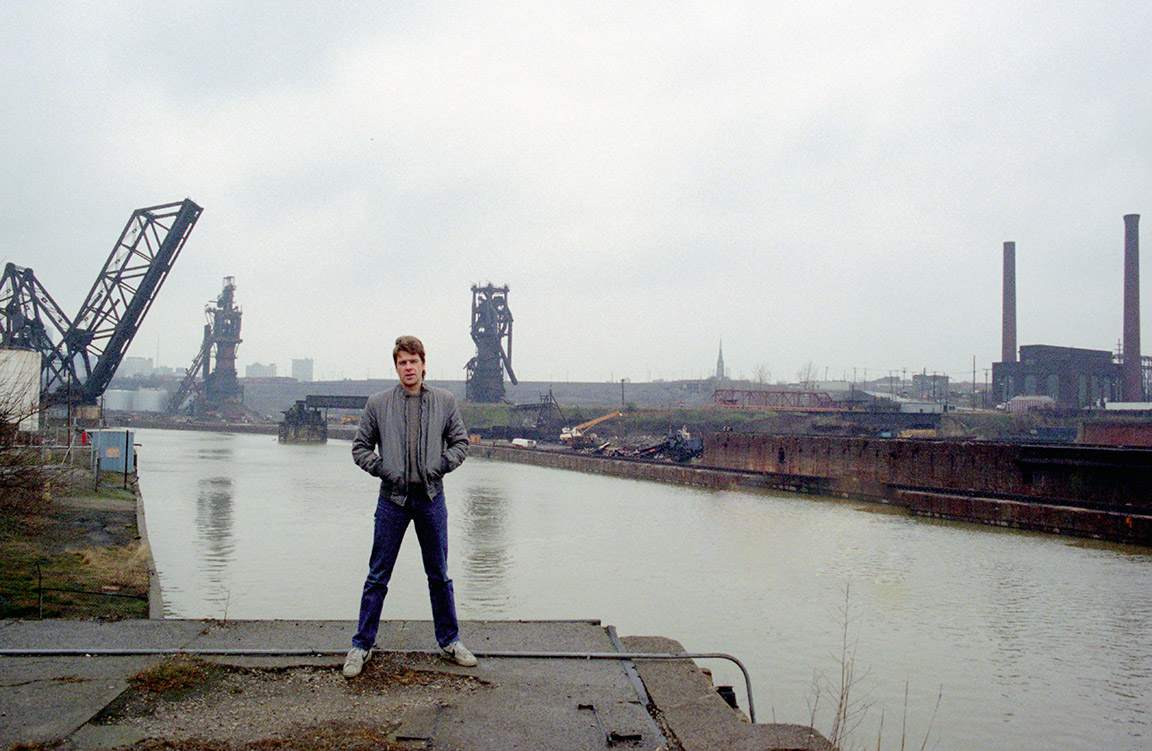
The author in 1980, where the Jefferson Avenue swing bridge was located. The Rust Belt didn’t take it out. It was a freighter that rammed it because it wasn’t opened, in 1952.
To the left is the B&O #463 jacknife lift bridge, soon to be demolished. To the left of the bridge was a Gulf Oil facility that was demolished. In the background are the remains of U S Steel’s Central furnace that dates back to 1900. That blast furnace to the left was a marvel when built, one of the biggest furnaces of its time, making mostly pig iron. To the right is the powerhouse for John Rockefeller’s Oil Refinery #1, and is the only thing left of the refinery. Off in the distance is the steeple of St. Joseph church, that was demolished in 1990. It was built in 1889, by German immigrants and was one of the most impressive churches in a city of churches. The river, of course, was known for catching fire in 1968, but it had always done that, including burning down bridges.
It’s all here the city lost almost 2/3 of its population and it’s capture includes Republic, steel, J&L Steel, US Steel, the old standard oil, refinery, numerous or boats like the Henry Steinbrenner, the Buffalo, the Calumet, as w=ell as, manufacturing plants like White Motors, Fisher Body, General Electric, Perrless Automobiles, Jordan Car Company, Forstn City Foundry, churches like St. Theodosius, St. Casimir and St. Joseph. Homes, bars, churches and factories are captured, almost all of which is gone.
You can also read the Introduction and text here.
VIEW the slideshow.