
In Why, Screens? the answer, off the top of my head, is comfort, but also manipulation. Naturally these folks would criticize originalty and truth.
Originality always was what it was but when it became clear that the orignal would disappear, an attack on originality ensued. It also Open the door to take anything you wanted and use it in your own work even if what you were taking was bloodwork, that is, original work that is, source work. Many forgot in their academic conceit, that the novel is accessible, as well as, a real life with meaning and purpose. It’s outside outside the screens. trending into screens nowbec we have seenoming mirrors.
A window or door isn’t a screen. That’s simple.

Obviously, the world is loaded with other options. None of them real. Just saying, while proving, that it’s possible to live, really, outside of screens, enjoying the positive and the negatives of that – soul, struggle, meaning, connection, purpose and discomfort.
Hubble-generated art is better than just about any painting I’ve seen, and it’s an unintended by-product. It’s reality based. No intention, no style, no interpretation. You really want to ignore what you can get out of this window from way out there, for a debate about representation? Clarity, an invitation into that which is, by a machine built at staggering cost, engineered with extreme precision, launched and maintained through collective human effort, produces images that could also function as the some of the greatest paintings ever made. Not by ambition. By clarity. It’s not a competition with painting. It’s not nose-thumbing to art history. It’s a fact of engineering. Money, labor, optics, physics, time. When those are aligned honestly, reality does the heavy lifting and concepts never stands a chance.
There is Mr. Farago’s point – stagnation? Hell yeah. But will the art world admit its role. Then it might move on, by rejecting, in hindsight, the flawed thinking that history has bored out. Once art went fully concept-centric, it convinced itself that ideas alone spoke truth. Photography was declared to have no special relationship to reality. All art was fiction, including photography. This was treated as sophistication rather than retreat. Language became the arena. Objects became secondary. Not just the arts and media, but every university in college department had seen huge increases as, until recently, a college education was seen as the key to everything. Thus, as part of the upscaling of America, articulation and language would take precedence over simple, hard work.
That logic didn’t vanish. It leaked outward. The people trained to doubt images, doubt facts, doubt plain description weren’t shut up. They stagnated. Big difference. Their thinking stopped advancing, but their tools traveled. Political operators didn’t invent this skepticism. They inherited it. Deconstruction didn’t stay in the seminar room. It migrated into right-wing podcasts and entertainment news, where it found amplification without friction. The what if, took conrol by implementation. It evolved, I remember seeing and hearing homeless people and drug addicts, speak of “signifcant” others and ptsd, not attending college, but watching television and things like Oprah Winfrey.The irony is unavoidable.
Steve Bannon didn’t invent this worldview from scratch. He passed through the same intellectual weather. There were the professors in the 1980s who dismantled meaning in art, language, and literature helped loosen the bolts. Without grounded intention (when you really got something to lose) others later applied the method to politics and a media of their own making. The right wing were no longer dependent upon the liberal media which they replaced by building their own. Reactionary but very practical as it has proven to be.
Political correctness and identity politics, its ad-infinitum to the point of minutae and irrelavance left the party of PC and IP became powerless and painted into a corner of their own making and a joke of powerlessness.
What followed after, the irrelevance of what was considered modErn and new during a time when that mattered, followed by an idleness with credentials, except for those invested. Not wild confusion, just stalled thought repeating itself. The old image still holds: the introverted thought architect dwelling behind the moon, now eclipsed by extroverted technicians who run the systems. A correction matters. With the exception of Musk, most of these figures are not extroverted. They are wealthy, inward, managerial technicians with a vision. Musk stands apart because he is an extrovert who builds, whose ambition is literal and physical. He wants Mars. He wants machinery. The rest are rich squares. Must has the confidence of an extrovert and thinks so clean is cool, but it ain’t. Outrageously none of the Mag Seven have ever asked any of us whether we wanted to go on their ride, particularly Musk’s ride to be the first on Mars and the stampede two exploit AI.
Bannon didn’t “learn to deconstruct government” the way a French academic would. He knew institutions hollow themselves out by watching the military, Wall Street, and media from the inside. Then he borrowed just enough theory to explain what he already believed. It wasn’t elegant. It wasn’t philosophical. It was practical, cynical, and opportunistic. Which, annoyingly, is why it worked.
Meanwhile, the concepts once spoken with clarity, decisiveness, and moral certainty now have no relevance whatsoever. They’re still alive and functioning, but, now used by the folks that they were reacting to, none of them know the source of distress, photography, and representation. That’s the real quagmire. Entire lives spent inside frameworks that no longer, or never, attach to anything solid. A genuine “now what” moment for people who believed language alone could carry a form of truth, or, just a form to carry their highly refined thoughts.
The drone, floating above things, always has the ideal view, and part of that is a certain comfort. Maybe something better lives in objects, but you must touch them.
Since the invention of the camera, show a group of people a photograph of a tree and all say, yes, that’s a tree. That agreement used to matter. Over the last twenty years, the number of people prone to deny that recognition has grown. The image didn’t change, in fact, got better with a camera/hybrid, that is far more sophisticated and efficient at capture. I still can’t help, but think, that before the phrase, fake news, 50 years past, were similar slogans of doubting media with clever phrases, such as photography, like all art, is just fiction.
Reinvention and disruption stopped being metaphors and transitioned to conceptual method and philosophy. Put your money where the power is. The anti-empathy ethic rose with the second Gilded Age of capitalism, which rejected the embarrassed tone about capitalism common from the 1970s through the 1990s when its critics referred to it as “late capitalism” The allleged clairvoyance of artists drifted, capitaists returned louder, more direct, and unapologetic, surpassing the first Gilded Age. Most of the working class aligned themselves with the great leader, Trump, and all of the billionaires. A weird combination and it stirred up a dormant socialism that could be weird as well in relation to it magnetic target. Hipster activists, with a knowledge of performance and culture not like the old workers in the struggle now aligned with Trump. What’s left is what’s left of the workin-class, but also the middle-class who are united by their unaffordable lives even with jobs and education.
Music and entertainment, the same shift. America moved from common folks’ grit to upscale individuality because that’s what the audience became. Not everyone, but enough. Springsteen fans still wrestle with the fact that the working class didn’t follow the soundtrack.
The lower-denominator acts, the ones engineered primarily for money, are the music of the president who acts like he’s for the working class. They fit perfectly. Built on performance, aggression, and spectacle, a desire for fame and wealth as ends. Upscale themes of individuality are the message. Get yours and get back. Material wealth wether by rap or pop, is performed with such drive and emotion, while love songs song written for overwrought zombies. In other words, not a lottta soul.
Traditional power freaks like the Klan or American nazis, no longer secretly parade around bonfires or wear uniforms the Nazi tradition in public displays. Today you got Nick Fuentes and fellow white supremacist party in suits ansd ties in upscale clubs, on the town, dancing to Kanye West’s latest song about Hitler.
No-slogans or schools, post-nothing, pre-nothing, against reinvention and disruption. Little truth in concepts floating free, countered by being embedded in things that function and endure as living and inaminate things, and erode or die.
One thing understood by a camera from its beginning. The machine never forgets something. Most importantly, the extraction is nothing but hard work. What did you expect? That’s what truth or whatever you call it, contact, soul, or being there has always been.
Since the invention of the camera, show a group of people a photograph of a tree and most will say, yes, that’s a tree. That agreement mattered. It was a shared recognition grounded in labor, optics, chemistry, time. Over the last twenty years, the number of people willing to deny that recognition has grown. The image didn’t change. The camera improved. The capture became more exact. The refusal came from somewhere else.
“Put your money where your mouth is” stopped being a phrase since money’s best use is to power and pecae through strength. Not metaphor. Not posture. A demand. That shift rose with the second Gilded Age of capitalism, which dropped the embarrassed tone that hung around from the 1970s through the 1990s. Capital returned louder, cleaner, unapologetic.
Reinvention and disruption went from sogans to both method and philosophy in a culture of remakes and cultural references. Look at music and entertainment and you see the same turn. America moved from common-folk grit and neurotic love songs to upscale individuality because that’s what the audience became. Not all, but enough. Springsteen fans still struggle with the fact that the working class didn’t follow the soundtrack.
Fame and wealth aren’t substitutes for grounding. No one thinks of being grounded but flying. The game itself, performance, sex and spectacle dominates material grounding. Politics mirrors entertainment because both answer to the same incentives.
No truth floating free. Great view, very comfortable and limited in a way that doesn’t show.
Truth stays embedded in things that function and endure whether living or inanimate. Only experience and work will prove it.
The camera understood this from the start with a machine that captures and never forgets. But only if directed to do so.
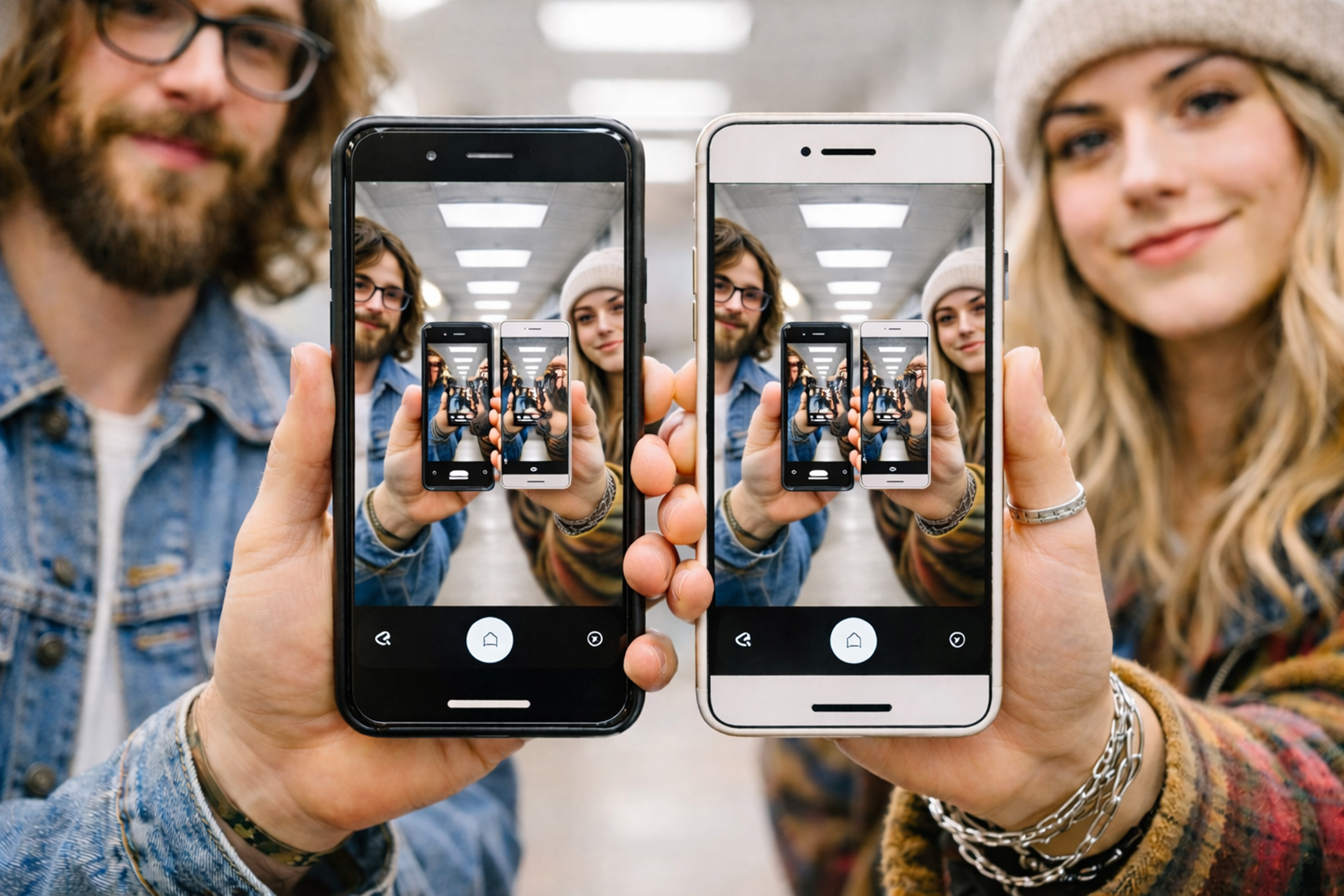
If you point a camera at a display that is showing the camera’s own output, you create a feedback loop. The image contains itself, inside itself, inside itself. What appears is a tunnel, a recursion, a hall-of-mirrors that seems to extend forever.
The umbrella terms are well established. Video feedback is the technical name. Infinite mirror is the descriptive, popular one. Recursive imaging is the conceptual term. All are correct. But none of them fully explain why the effect matters.
That’s why the effect feels unsettling. You are not seeing duplication. You are seeing self-reference under entropy.

Looking back at past philosophical commentary by the enlightened artist of the so-called postmodern era said wierd stuff like “photography has no special relationship to reality or truth” or, “All is fiction in the arts and medias.” I would counter with, most recently, what if, there were no cameras when Alex Pretti was the target of so many bullets? If his camera/phone was still turned on then he would have. at the least, recorded the sound of hiw own death.
See what you started? The camera has no special relation to truth? Tell it to the thousands doing serious time because they were caught on surveilance cameras, or, even, in sports with replay. Cold, clear and objective is the surveillance standard, so much so, that only the replay is believed.
A camera can distort just as easily, dependent on the purpose and the operator who decides the level of filtering both physical and ideological. It’s views, can be a window or a mirror, depending on who is the operator.
Capturing and screening, is done by one, or a crew, for the many. The capture, requires being there, is work. Screening is seeing the world in comfort in a framed edit. Remember if people didn’t have their cameras that day, there would be no truth.